What Does the Ulay/Marina Abramović Exhibition Offer?
August 19, 2026
Ana Kutleša visited ART VITAL – 12 Years of Ulay/Marina Abramović, on view at Cukrarna Gallery in Ljubljana until 10 May 2026. Her text reflects on the 12 years of shared life and artistic practice of this renowned artist couple, from 1976 to 1988.
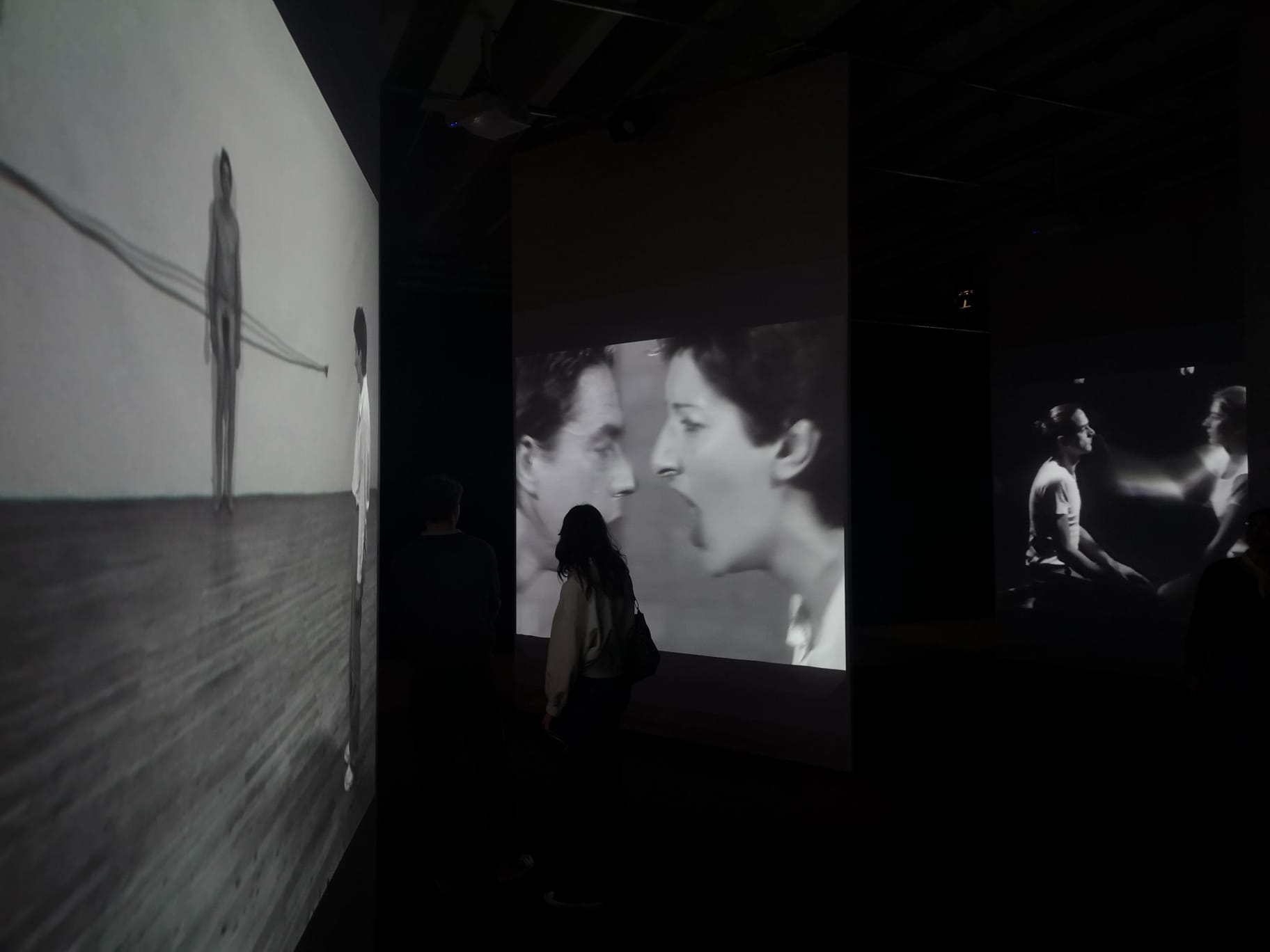
Exhibition set-up photo: Ana Kutleša
“The modern art world can be divided into two groups: Izabella Barta and everyone else” – thus Helen Mirren, playing a television host, opens the mockumentary Waiting for the Artist, in which Cate Blanchett offers a caricatured portrayal of Marina Abramović. Like the fictional Hungarian artist Barta, Abramović stands alone against everyone else in the contemporary art world – the only one among them who had the honour of being mocked in the American mockumentary series Documentary Now!.
Marina Abramović is a unique figure within the field of contemporary art, not least for having mythologized her artistic persona to the point of parody, making millions in the process despite working in the generally not-so-lucrative field of performance art – all while coming from a peripheral European country that has since ceased to exist. At the same time, several of her ventures have seriously compromised her reputation, including controversies surrounding unpaid labour,[1]her solo exhibition at the Museum of Contemporary Art in Belgrade,[2] and the never-realized, monumentally ambitious art centres proposed for Hudson and Cetinje.[3]
It was therefore not easy for me to enter the exhibition ART VITAL – 12 Years of Ulay/Marina Abramović at Cukrarna Gallery with an entirely open mind, particularly as the venue itself shares certain characteristics with the artist. Monumental and spectacular, it has been conceived, designed, equipped, and even programmed according to the highest standards of Western art centres, making it unique within the former Yugoslav region. And yet, ART VITAL is not a solo exhibition of Marina Abramović, but is devoted to her collaborative practice with the German-Dutch-Slovenian artist Ulay between 1976 and 1988. Ulay, whose full name was Frank Uwe Laysiepen, died in Ljubljana in 2020. This is the first comprehensive presentation of their artistic partnership, curated by Alenka Gregorič, artistic director of Cukrarna, and the Austrian curator Felicitas Thun-Hohenstein.
Precisely because of the way Marina Abramović is perceived today – as a singular figure, regardless of whether our response to her is critical, mocking, or admiring – the very fact that she appears here as one half of an artistic couple is intriguing in itself. Her works with Ulay are, of course, well known even to a broader public, particularly their final, farewell performance, The Lovers: The Great Wall Walk. Yet when Ulay sat down opposite Abramović at her table at MoMA in New York during The Artist Is Present in 2010 and the video of their encounter went viral, it was possible to feel that their shared artistic practice had somehow been reduced to yet another episode in her fascinating life.

“Art Vital”, ground floor, ©Blaž Gutman/MGML

“Art Vital”, ground floor, ©Blaž Gutman/MGML

“Art Vital”, 1st floor, ©Blaž Gutman/MGML

“Art Vital”, 1st floor (right), ©Blaž Gutman/MGML

“Art Vital”, 1st floor (right), ©Blaž Gutman/MGML
Upon entering Cukrarna, we encounter two enormous black vases: the work Vases, which belongs to the final phase of their relationship, just like the aforementioned The Lovers, projected just around the corner onto large surfaces – a mode of presentation used for video works throughout the exhibition. Just beside them stands another striking black object: the van in which they spent the first five years of their avant-garde nomadic venture, responding to invitations from galleries and art institutions and producing works in accordance with the Art Vital manifesto. It is immediately clear, then, that the exhibition does not approach its subject linearly, but instead unfolds in a kind of spiral throughout Cukrarna, interweaving video works, photographs, objects, and archival material across five floors. On several occasions, the same work is presented in more than one place – once through documentation, elsewhere as a video installation, and elsewhere again through references in archival materials. In this way, the exhibited works gradually accumulate, presented first as monumental moving images and then revisited through narratives that reveal more about the circumstances of their creation, which can be particularly useful for younger and broader audiences who are less familiar with the subject matter. The decision to occupy the entirety of Cukrarna with the exhibition, however, can be read less as a necessity dictated by the quantity of material than as a gesture in keeping with the themes of monumentality and uniqueness, since the material does at times feel somewhat overstretched.
The works themselves – series of performances such as the earlier Relation Works (including the particularly influential Relation in Space, Imponderabilia, and Breathing In/Breathing Out), or the later Nightsea Crossing, to name the best-known examples – have been the subject of numerous analyses and studies. Across the 12 years of their collaboration, we can trace a transformation of both their relationship and their practice, already evident in the contrast between the (literal) bareness of the early black-and-white works and the costumed bodies and use of colour in the later ones – colour here being not merely a consequence of technological developments, but a deliberate use of chromatic symbolism. What they all share, however, is a certain conceptual concision and a relatively long duration, in which a static situation or prescribed gesture is sustained or repeated to the limits of endurance, opening up a broad experiential and interpretative field. The position of the viewer is what allows their performances to be divided into works performed before an audience and those carried out exclusively, or almost exclusively, for the camera, such as the early Relation in Space and Breathing In/Breathing Out, or the somewhat later Rest Energy.

“Art Vital”, 2nd floor (left), ©Blaž Gutman/MGML

“Art Vital”, basement, ©Blaž Gutman/MGML

“Art Vital”, basement, ©Blaž Gutman/MGML
Interestingly, performances from both groups function equally well as video works, and at Cukrarna they are projected onto large surfaces whose three-dimensionality and placement within the space create the impression of monumental moving images. Particularly striking is the installation in the basement, reserved for enlarged videos from the Relation Works series. The naked bodies and close-ups of Abramović’s and Ulay’s faces emerge from the darkness, commanding the viewer’s attention. Also, intriguing relationships arise between the works themselves, beginning with the rhythm imposed by the slaps exchanged in the performance Light/Dark. Clearly, in the case of works performed before an audience, the experience of live participation remains irreproducible, and the video recordings are not intended to replace it, but rather to create a new work from the given situation, with an experiential quality of its own. All of their videos were directed and filmed in ways that go beyond mere documentation, thereby facilitating their entry into museum collections and exhibitions, which is no simple achievement for performance art.
In Damjan Kozole’s documentary about Ulay, Project Cancer (2013), Marina Abramović states: “We both brought some baggage [into the relationship] – I brought my suitcase of performance, while his suitcase contained photography.” And moving image, one might add. In addition to the videos discussed above, Art Vital presents a wealth of photographs, including archival contact sheets, yet their authorship is largely left implicit, suggested by the absence of credit to a third author and only occasionally indicated through references to Ulay in the context of photographic and video documentation. The fact remains, however, that before his relationship with Abramović, Ulay had produced a number of remarkable photographic series that art history only began to reassess in recent decades, and that he carefully directed the photographic and video recordings of their joint performances, leaving the assistants merely to press the shutter.[4] He also developed and archived the resulting material (they even kept a small refrigerator in the aforementioned van specifically for storing film), thereby greatly facilitating the dissemination of their work and, ultimately, its sale. That Marina Abramović benefited from this far more than Ulay did became particularly clear after their separation, when she went on to build an international career as a highly visible and commercially successful artist, and ultimately in 2015, when the two faced each other in court. At the end of the proceedings, Ulay, the defendant, was awarded several hundred thousand euros in royalties.[5]

“Art Vital”, ground floor, ©Blaž Gutman/MGML

“Art Vital”, ground floor, ©Blaž Gutman/MGML
The exhibition at Cukrarna quite legitimately begins and ends with the 12 years of their collaboration without referring to later developments – whether the moving viral encounter at MoMA or the rather less moving one in the courtroom. Although it is not particularly exhaustive in explaining how the photographic and video documentation was produced, it cannot be said that Ulay’s authorship is in any way relegated to a secondary position. Alongside the two curators, the exhibition is the work of a broader team that includes Marina Abramović, as well as Lena Pislak, Ulay’s long-term partner until his death, who organised his archive while he was still alive and continues to manage it today. Relations between Ulay, Lena Pislak, and Marina Abramović had, however, already been reconciled during the artist’s lifetime,[6] which undoubtedly made the curators’ work considerably easier and, indeed, made this exhibition possible. Archival material drawn from both archives constitutes an important aspect and is dispersed across several points in the exhibition set-up, in some places serving to supplement individual works, while on two occasions it is displayed in a more concentrated form. The first is located on the ground floor, in a section separated from the rest by broad semi-transparent strips. In display cases, we encounter correspondence ranging from love letters to official exchanges with galleries, as well as drawings, sketches, and notes, while above them hang photographs, contact sheets with individual images marked out, and other materials that reveal the processes behind the iconic performances.
The second point in the exhibition where archival material is brought to the fore is the mezzanine. A sloping upholstered platform transforms the entire area into a space for sitting and relaxing, with numerous tablets on which visitors can browse the archive. One of the large walls is given over to a projected television segment, which feels somewhat isolated since it is difficult to believe that this was the only material of its kind available, while the content itself is not particularly compelling. The space is kept in semi-darkness, while the tablets, lacking any labels that might indicate how the material is organised, allow for little more than random browsing, page by page. The overall impression of this “archival” floor is therefore somewhat disappointing – as though the aim were merely to satisfy the formal requirement of an interactive, accessible archive and to fill the space. Instead of fostering an atmosphere of working and researching, it becomes a place where visitors merely take off their shoes and rest their feet.

“Art Vital”, ground floor, ©Blaž Gutman/MGML

“Art Vital”, ground floor, ©Blaž Gutman/MGML
Another not particularly successful archival intervention appears on the ground floor, where correspondence with galleries and institutions from the period of their nomadic life is projected from ceiling to floor, beside the van. The letters, detailing who invited them and under what conditions, offer a revealing insight into the conditions of artistic work at the time, and displaying them alongside the van is an excellent idea, but the rapid succession of scans, combined with the reduced legibility of the enlarged text, makes them difficult to read. The treatment of the archival material can thus feel somewhat inconsistent, and the extent to which it provides rewarding insights depends largely on the visitor’s patience. It should also be kept in mind, however, that the final result reflects the conditions under which the exhibition was produced – the curators’ collaboration with Marina Abramović and Lena Pislak, as well as the amount of time they were able to spend working in the archive and subsequently interpreting the material.
A large part of the archival material consists of extremely intimate content – love letters and diary entries that place the reader in a voyeuristic position. This raises the question of what they reveal about Marina Abramović and Ulay’s artistic practice itself; despite their professed but also genuine exploration of extended vulnerability (one of the tenets of the Art Vital manifesto) and the possibility of a complete merging of two beings, is there nevertheless a dimension of their relationship that they shared with other, “ordinary” couples? Could it be precisely for this reason that it is important to see these letters – to remind us that, in the end, these were simply two people who, for all the extraordinary art they produced, were not quite as larger-than-life as their artistic personas might suggest? Elsewhere in the exhibition, enlarged transcripts of Marina Abramović’s dreams are displayed – dreams to which prophetic significance was attributed (primarily by Abramović herself). While browsing the archival material on one of the tablets, I came across a brief diary entry in which the artist, then in her early forties and on the verge of separating from Ulay, laments that she is looking more and more like her mother and resolves that she needs to work on herself and exercise more. Such traces of entirely ordinary life experiences are precisely the points at which the exhibition helps dispel the mythic haze Marina Abramović has built up around herself. The part of her career defined by her partnership with Ulay is, in fact, a logical starting point from which to begin questioning the myth of the lone artistic genius.
Ana Kutleša
(translated by Tihana Bertek)
We thank MGML Cukrarna for providing the visual materials.
[1] https://hyperallergic.com/marina-abramovic-institute-seeks-so-much-unpaid-work/
[2] https://www.masina.rs/vanredno-stanje-u-kulturi-muzej-savremene-javni-konkurs-i-izlozba-marine-abramovic/
[3] https://hyperallergic.com/marina-abramovic-institute-money/, https://www.vijesti.me/zabava/309773/marina-abramovic-stize-u-septembru-da-odmrzne-cetinje?utm_source=chatgpt.com
[4] https://www.sfaq.us/2025/10/ulay-act-iii/
[5] https://www.theguardian.com/artanddesign/2016/sep/21/ulay-claims-legal-victory-in-case-against-ex-partner-marina-abramovic
[6] https://www.youtube.com/watch?v=8m9PveBXizQ