Conversation with Darko Šimičić about the artistic practice of Željko Jerman.
“He was unstoppable and curious” – Darko Šimičić on Željko Jerman’s artistic practice
October 2, 2025

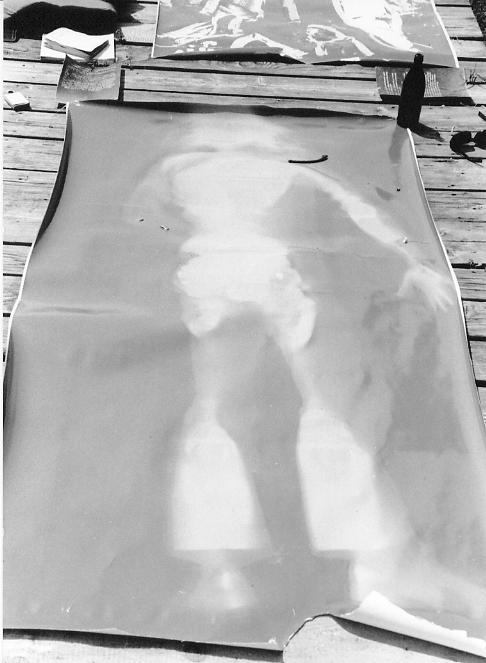
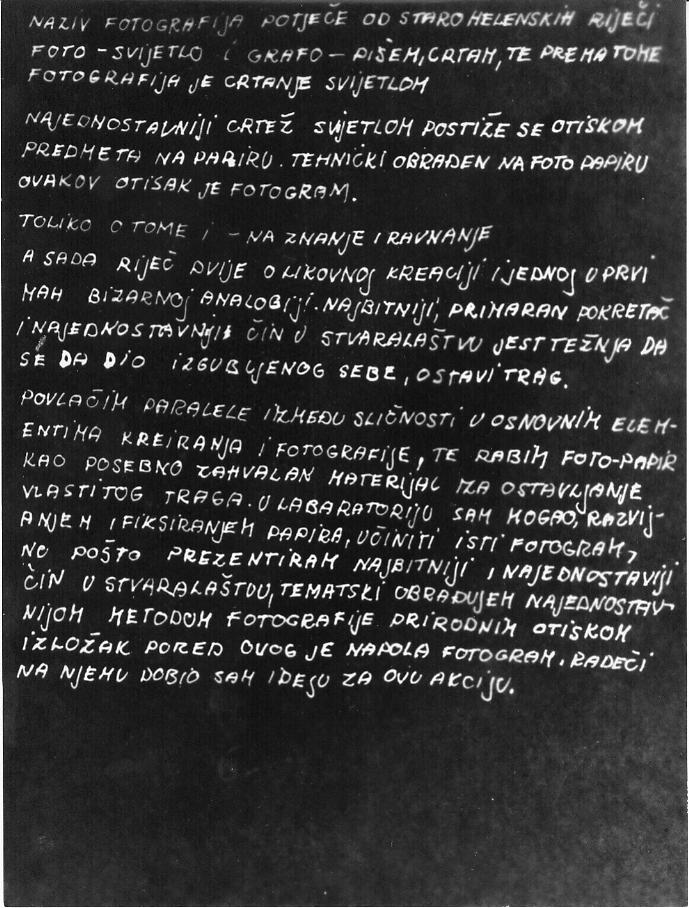
Željko Jerman, “I’m Leaving a Trace”, 1975
Do you remember your first encounter with Željko Jerman? When and how did you meet?
I became acquainted with Jerman through his work. I saw the exhibition My Year, which was set up at the Studio of the Gallery of Contemporary Art in January 1978. What captivated me was Jerman’s touching sincerity and the idea of art expressed through highly reduced means. A4-sized paper, a black-and-white photograph, date and short note. We met in person shortly after that, at Blato, a bar popular with artists at the time. We really started socialising at Podroom in Mesnička Street no. 12. I had been frequenting the place since the first exhibition opened in May 1978.
Željko Jerman was a member of the Group of Six Authors, who, according to Ješa Denegri, had their own exhibiting, operational and theoretical strategy, and, ultimately, an ideological and political stance. How would you describe Jerman’s position within the group?
The story of the Group of Six has its own prehistory. Martek and Demur had known each other since childhood. Their acquaintanceship with Jerman dates back to the late 1960s. Later, Demur’s girlfriend Lida and Branka Stipančić became friends, and they started hanging out with Mladen and Sven Stilinović and finally with Fedor.[1] They were friends who each expressed their own creative impulses in their unique way. Jerman, like many others at the time, was fascinated by Antonioni’s feature Blow Up. The formula is youthfully simple, the camera made it easier to interact with girls. Martek, Demur and Branka, Jerman’s wife at the time, were the most frequent models for his photographs. When they started acting as a group, through exhibitions-actions, Jerman drastically expanded his field of activity, introducing new elements, such as performative actions, as part of his work process. He intensified his use of the textual medium as an integral or entirely independent segment of artistic work. Jerman’s inexhaustible energy was evident both in his solo works and the activities of the group.
Can you tell us more about the photography studio Blow Up in Zagreb, which Željko Jerman opened after getting his photography certification?
The Blow-Up phase of Jerman’s work was before we met. Here’s a curious coincidence: in 1970, Plavi vjesnik [Blue Herald], which all the teenagers read, published a full-page article titled: “A Hippie with a Craft” illustrated with a photo of a long-haired young man. When I read that, there was something enchantingly romantic in the description of a long-haired photographer who turned his craft into a dialogue with potential clients. For a long time, I kept that photo up in my room in Slavonski Brod. Only much later, when I had known Jerman for some time, did I realise that the article was about him.
From the very beginnings, the medium of photography was vital to Željko Jerman’s artistic practice. Do you remember the context in which the 1973 piece Drop Dead Photography was created?
Jerman always singled it out as the key piece in his oeuvre. A text written in a felt-tip pen and tempera on photographic paper, without the use of a camera or photochemicals, is truly a radical, destructive act. In Jerman’s case, every end is a new beginning. I like to quote Miško Šuvaković who said that the history of photography could be divided into two periods, before and after Drop Dead Photography. I am the proud owner of this masterpiece.
As early as 1975, Jerman presented his photographs in a solo exhibition at the Centre for Photography, Film, and Television (CEFFT) with the support of Radoslav Putar, who wrote the accompanying text for the exhibition. Do you remember that exhibition? How did the collaboration with Radoslav Putar come about?
I know about this now historic exhibition from Jerman’s stories and catalogues. Why is this exhibition important? It was a retrospective of Jerman’s five-year body of work, spanning the period from 1970 to 1974. He exhibited photographs that represented a transition from deliberately grey photographs to interventions in the development process. Jerman combined negatives, blank surfaces, scribbles, photograms, text…, creating a unique work of art. He stepped outside the usual format of photography, tearing, cutting them up, mounting them on pressboard and adding colour. All of this speaks to an unbridled process of struggle and searching. Drop Dead Photography, Oh, My Paper, I Tear Up Pictures and They Break My Bones: these are not declarative statements, Jerman is literally wrestling with the photographic medium. He emerges from this struggle with new-found experience and embarks on new adventures.
In reference to that exhibition, I remember Martek’s story, about how he, Demur and Jerman invited Radoslav Putar to look at their works in Demur’s room. Putar studied the works with interest and had a lively discussion with the then very young radical artists. In the end, Jerman’s exhibition was realised in February 1975. It was the first exhibition at the newly established Centre for Photography, Film and Television (CEEFT) of the Zagreb City Galleries. Less than three months later, Jerman and his friends held their first exhibition-action at the city bathing area on the Sava River.
The work My Year (1977) brings together photographs with which Jerman recorded his own everyday life and simple journal entries. A year later, this seminal piece was exhibited at the Gallery of Contemporary Art (GSU). Can you tell us more about the work and the GSU’s ambition to exhibit it so soon after its creation?
MyYear is a truly important work because it reveals Jerman’s ideas about life and art. The photographs that depict Jerman in his daily activities are complemented by short writings. These statements are painfully convincing, relaying Jerman’s stream of consciousness. This influential photographic work represents a critical departure from the traditionally established role of the photographer. That is, a photographer is someone who holds a camera in their hands and creates a work of art, just as a painter would do with paints on canvas. Jerman, the photographer, offers up his camera, for other people to take pictures of him: the role of subject and object is reversed in the process. In the piece, Jerman, like Tomislav Gotovac, takes on the role of artist-director, letting others realise his idea.
The curators of the Gallery of Contemporary Art supported Jerman’s work. He exhibited there several times, both in solo and group exhibitions, and entered the Gallery’s collection early on. Coming across My Year at the exhibition in January 1978, which was right after the work was completed, I slowly read out the texts, observed the photographs, and thought about Jerman’s as well as my own feelings. I think I went to see the exhibition several times. I thought the ideal format to present this material would be a photo book that you could leaf through, read, put down, and re-read. I am proud that I managed to realise this idea in 1998, when I edited the book, published by the Institute for Contemporary Art. Incidentally, displaying this work in a “wallpaper” format, as it was done at the new building of the Museum of Contemporary Art, was not a very effective solution since it did not allow for viewing and reading.
Did you ever discuss photography with Jerman? What were his thoughts on the photographic medium? How did Jerman himself interpret elementary photography?
Jerman liked to talk about art and viewed his own work through that prism, but he did not much care for strict classifications of the mediums. He used photography in all possible ways. From creating real photographs, the right to make mistakes, deliberate destruction or inventive transformation, to the idea of using photo paper as the setting where actions take place. This could be creating an imprint of one’s own body, writing a text-process or a text-slogan, or conducting performance actions of burning or tearing up photo paper, exposing film or paper packaging, and many other activities. Finally, in many of his works, photography serves to document the work process. Of particular importance is a large cycle of works in which he explores chemical reactions on the surface of photographic paper. Jerman was a force of nature, an unstoppable and curious artist who treated photography in the same way that Van Gogh treated the surface of his canvases with paint, creating some of his most beautiful paintings. Elementary photography for him stood for an analytical process, an attempt to dissolve the artistic process all the way to its beginning, to ground zero. It is no coincidence that his fellow artists likewise reduced their works to analytical processes – Demur did this in painting, while Martek and Mladen Stilinović did it with words and meanings.
Deconstruction and a penchant for experimentation were the hallmarks of Jerman’s artistic practice. How did you perceive Jerman’s practice in the 1970s, and how do you regard it today?
Jerman and the other artists of that period allowed the art of the era to assume firm ethical positions, relegating aesthetics to merely incidental baggage. The artists of the era taught all of us what art can be.
Can you speak about the performativity of his works?
At the first exhibition-action, Jerman performed one of his key works. He lay on a large piece of photo paper for about an hour, leaving behind a natural imprint of his body. He did not use a fixer, so, over time, the imprint disappears. Along with the imprint, he exhibited a paper explaining the work. In it, he states: “The first driver and simplest act of creating is the desire to give away a part of the lost self, to leave a trace. I draw parallels between the basic elements of creation and photography, and I use photo paper as a particularly workable material for leaving my own trace. I could have made the same photogram by developing and fixing the paper in a lab, but since I am presenting the most essential and simplest act of creation, I am processing it thematically by using the simplest method in photography, a physical print.” Two years later, Jerman exhibited four body prints in a solo exhibition at the Nova Gallery: on photographic paper, X-ray, in concrete and in sand.
How did the audience perceive Jerman’s works at the time they were being created, and how does it perceive them today?
I think Jerman always managed to intrigue the audience and his exhibitions were always well attended. Most of these visitors were his friends and acquaintances because Jerman was very sociable, but there were certainly serious observers of his work as well. He enjoyed mostly favourable criticism, with Putar and Ješa Denegri writing about his work. Jerman also received a terribly unfavourable review of the exhibition My Year, when influential critic Vladimir Maleković, in a hysterical assessment spanning almost half a page, stated in Vjesnik, that Jerman’s work belonged more to sociology and psychopathology than to fine art. And Jerman, being Jerman, had that text printed on the invitation to the Punk Art exhibition at Podroom attracting a multitudinous audience.
Can you share an interesting anecdote with Jerman? How did archiving his material come about?
Jerman was constantly on the move and did not feel like collecting much documentation about his work. I, on the other hand, collected everything, every invitation, flyer, catalogue, anything from which I could learn something. Jerman entrusted me with all of his records, saying that it would be easier for him to ask me for the information about his work than for him to do all the archiving.
It is interesting to note that Jerman was also an active writer – he not only employed text in his works, but we now also have the opportunity to read his writings about his own artistic practice and work, and he wrote reviews and creative texts published in Polet, Studentski list, Studio, Zarez, etc. What were these texts like, why was that segment important to him?
Jerman was very good at noticing and articulating the important aspects of his own and other people’s work. He wrote reviews of his friends’ exhibitions, which were often their first reviews. He was involved as a curator on different occasions and put together several very interesting exhibitions. His later texts were quite hermetic, but these were again Jerman’s innovations.
What does Jerman stand for today in the context of domestic art history?
Jerman was an extraordinary artist who changed many things. I think he left a body of work in the medium of photography that could still be considered very radical even today.
How would you describe Željko Jerman as an artist and as a friend?
There was never a dull moment with Jerman, he was very funny, entertaining but also very dedicated to his artistic ideas. I learned a lot from him, he invited me to do an exhibition at Podroom and to participate in the magazine Maj 75.
In 1978, Jerman created the Unique Book. Awareness, in which he clearly indicates all the roles (tasks) he undertakes to accomplish it. How do you interpret this awareness of the segments of artistic procedures, which are also accompanied by the “technical” aspects (printing house, editor, performer, etc.), in the context of his practice? Are these aspects equal to artistic ones, can we even distinguish which are more important?
This book is a good example of Jerman’s analytical approach and reflection on his own artistic practice. It is another great example of how Jerman did not limit himself to divisions between different mediums, instead simply realising an idea in the medium appropriate to it.
Do we now know who filmed and photographed his performances? Did he explain everything in detail, or did he leave the choice of shots and similar details to the person behind the camera?
The filming was always done by friends, someone from the group, or a completely random individual. From the end of 1977 to the mid-1980s, Vlasta Delimar, who was his wife at the time, was the one who often photographed him.
_________________________________________________
[1] The Group of Six Authors consisted of: Boris Demur, Željko Jerman, Vlado Martek, Mladen Stilinović, Sven Stilinović, and Fedor Vučemilović.