The Spot Gallery and the Office for Photography invite you to the opening of the exhibition Bombardelli: An Open Archive of Memory, Experience, and Urban Possibilities by the artist Duška Boban, which will be held on Monday, 11th May 2026, at 7:00 p.m. The official opening with a guided tour and a talk with the author of the exhibition starts at 7:30 p.m. As part of the exhibition, a workshop “First House” by the artist will be held on 28th and 29th May in the Spot Gallery. The exhibition will remain open until 29th May 2026.
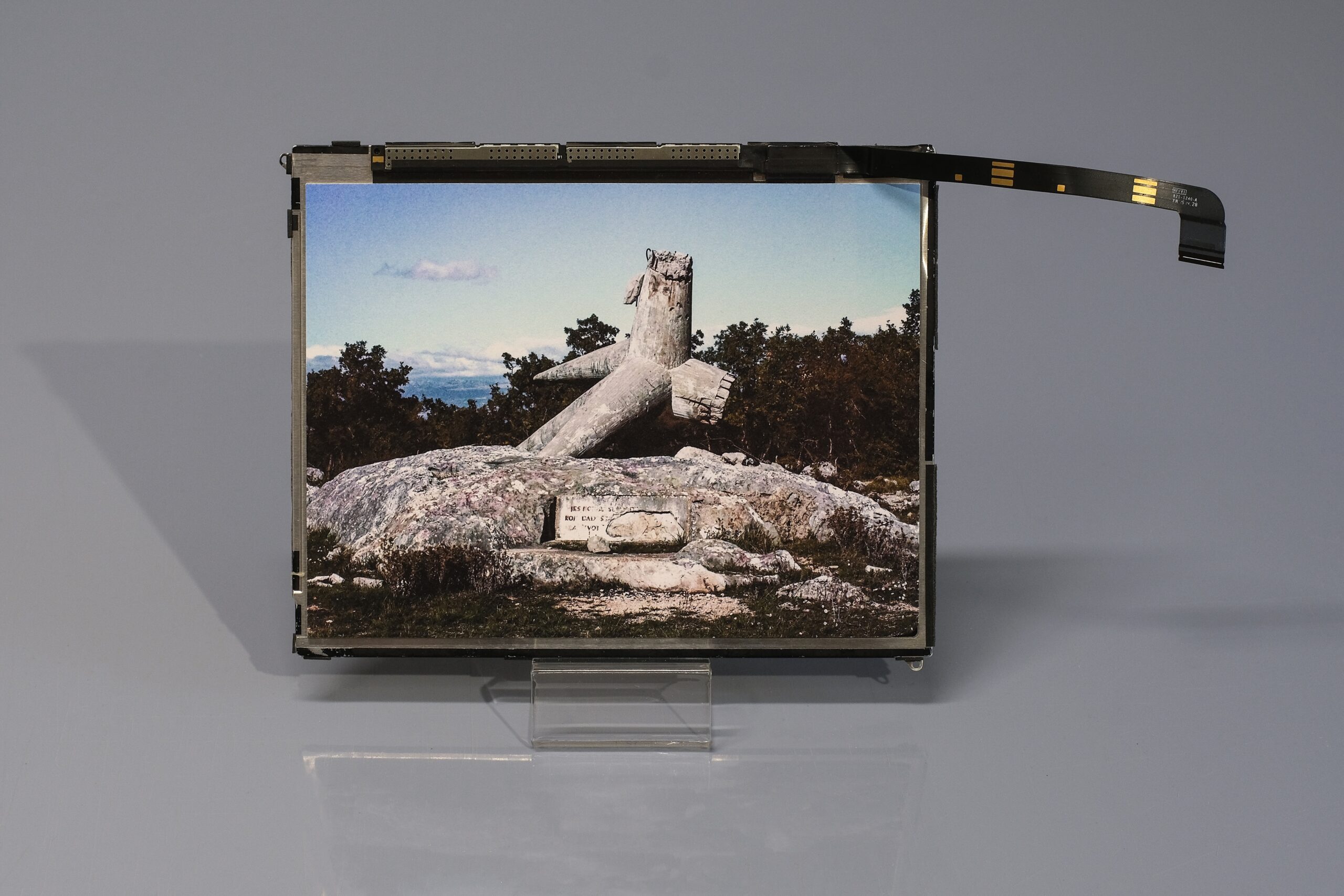
Duška Boban, from the project “Vuko Bombardelli: An Open Archive of Memory, Experience, and Urban Possibilities”
To Unfold the House Within – Duška Boban and Vuko Bombardelli
“If we have retained an element of dream in our memories, if we have gone beyond merely assembling exact recollections, bit by bit the house that was lost in the mists of time will appear from out of shadow.”
Gaston Bachelard 1
How do we archive something larger than what we are able to grasp? For instance, a space, a historical moment, a social reality we did not witness ourselves but only heard about, unsure whether the version we are hearing is accurate. How to translate into a small format a work that is removed from the viewer’s gaze – a work we know was there, but is impossible to “translate” for the purpose of an exhibition because its scale is measured against the hillsides that enfold the city? What artistic approach is adequate to make visible the fact that each of the carefully conceived volumes designed by Vuko Bombardelli had its reference point in a society that has since changed? What is to be done when contemporary society no longer accepts the values of the past, because what was created, designed, and inherited is marked by socialism, which has become unpopular and is now to be avoided at all costs?
In her durational project Vuko Bombardelli: An Open Archive of Memory, Experience, and Urban Possibilities, Duška Boban works across several levels and in multiple media. Her research is rooted in metagenealogy and grounded in a therapeutic approach which unfolds in layers, offering the audience a series of insights into the artist’s discoveries about herself and her family. Among other things, the project reveals connections between people and places that existed in a particular historical moment. These relationships are worth revisiting, as they offer a distance from contemporary patterns of behaviour and the constraints imposed on us by others. Perhaps this may help us to better understand certain situations; perhaps it may also draw attention to the problem of (dis)continuity in memory. Duška’s project offers at least a temporary sense of healing that we crave, even as the actions of others and a broader lack of understanding continue to threaten our mental and emotional equilibrium.
The term metagenealogy entails processes that are simultaneously artistic and therapeutic, but what interests me here is how the prefix meta- might be further mobilised in relation to Duška’s exhibition. How can photographs, film excerpts, family and architectural photo albums, and the model of the kiosk that Bombardelli placed at the bottom of what was then Solin Road – a structure into which his diverse architectural experiences symbolically converge – point to the need, or at least the intention, to create a meta-archive of ideas and realizations in the fields of urbanism and architecture? Together, these materials testify to a major transformation in Split during the second half of the 20th century, when spatial relations and social engagement reached a remarkably high level – one that is now increasingly called into question.
Duška’s artistic approach does not subscribe to the logic that prevails in archives, nor to the hierarchy that arises from a single viewpoint structured according to someone else’s rules. Instead, she opts for the study of relations shaped by views down the street and towards the neighbouring house; she is interested in the rhythm of shifting volumes and the movement of air, the configuration of the coastline as it is gradually worn away, and the line along which her mother’s and father’s family histories meet – one tied to the Dalmatian hinterland, the other to the coastal region. Through a series of gestures, the artist revalues her own heritage, her roots and family, and the albums she would look through as a child, while also taking into account those that have not been fully available to her (since the impulse to hide is also inherent to archival material, potentially intended for the future).
Everything is here: Marjan and Spinut, the smoke rising from the factories in Kaštela Bay, and the combination of modernism and rustication on the facades of apartment blocks. The steps leading up to the terrace of a house overlooking modern Split, the sea, the mountains, and the monuments – one damaged in Košute, the other preserved in Ruduša. The archive also includes an 8mm film shot by Vuko Bombardelli during a May Day picnic in the Sinj region, while the hedonism of his Blue Highway was captured on film by another architect, Duška’s uncle, Natko Boban. She activates all of these seemingly severed connections not as the custodian of some imaginary archive, but as someone claiming the right to create it. And it is precisely this right that is the crucial feature of her method, more so than the making of an actual physical (or digital) collection of gathered material. Fundamentally feminist in its orientation, her approach foregrounds the need to transform standard archival procedures in favour of those in which the participants are directly involved in the process, capable of shaping its content, space, and timeline, including this unique performance of the archive. In this way, the artist takes part in an ongoing, circular process of self-archiving practice, articulating the kind of society we would want to be remembered.
Sandra Križić Roban
1 Gaston Bachelard, The Poetics of Space, New York: Orion Press, 1964, p. 57. Translated by Maria Jolas.
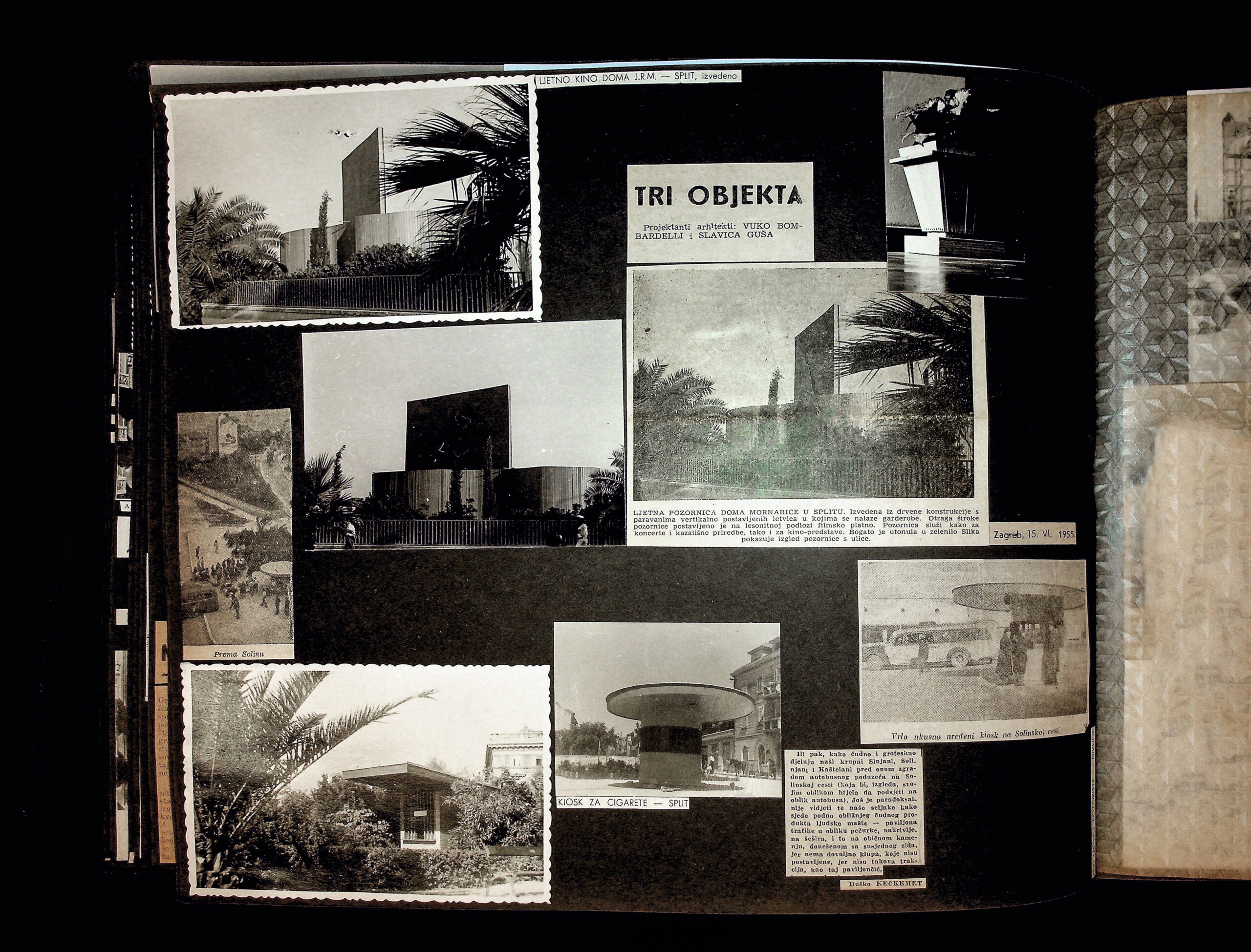
Duška Boban, from the project “Vuko Bombardelli: An Open Archive of Memory, Experience, and Urban Possibilities”
Duška Boban is a visual artist based in Split, Croatia, working across photography, artistic research, and activism. She focuses on urban memory, Mediterranean modernist heritage, and social and environmental issues. She graduated from the Academy of Fine Arts in Zagreb and completed postgraduate studies with her master’s thesis titled “Public Space and Civic Participation: Activism and Cultural Practices in Split during the Last Decade” at the Academy of Fine Arts and Design, University of Ljubljana, where she is currently attending the interdisciplinary doctoral programme. In addition to her art, she has been active in education for many years, teaching photography and media at the School for Design, Graphics and Sustainable Construction, and leading workshops, including therapeutic photography programs, for people of different ages and backgrounds. Her projects often link art with civic participation and the right to the city. In 2011, she started the Initiative for Marjan to help protect Marjan Forest Park. She co-published the book Amorella – A Floating City (2019) with Nikola Bajto and the Croatian Maritime Museum Split, exploring Split’s shipbuilding heritage as part of her wider research into urban life. In 2024, she won the RADNIČKO competition and created the site-specific artwork Architexture for the Zagreb Public Open University. Her works are part of the Museum of Fine Arts Split’s collection.
Related events:
- Guided exhibition tour and conversation with the author, 11th May 2026, 7:30 p.m., Spot Gallery
-
Workshop “First House”, 28th and 29th May 2026, 6:30 – 8:30 p.m., Spot Gallery