As part of the “Regional Photo Focus” section, which explores themes and festival events from across the region, we bring you a conversation between Tena Starčević and artist Marisol Mendez, whose work Padre was named the winning work of this year’s Kranj Foto Fest.
Kranj Foto Fest: Conversation with Marisol Mendez
September 23, 2026
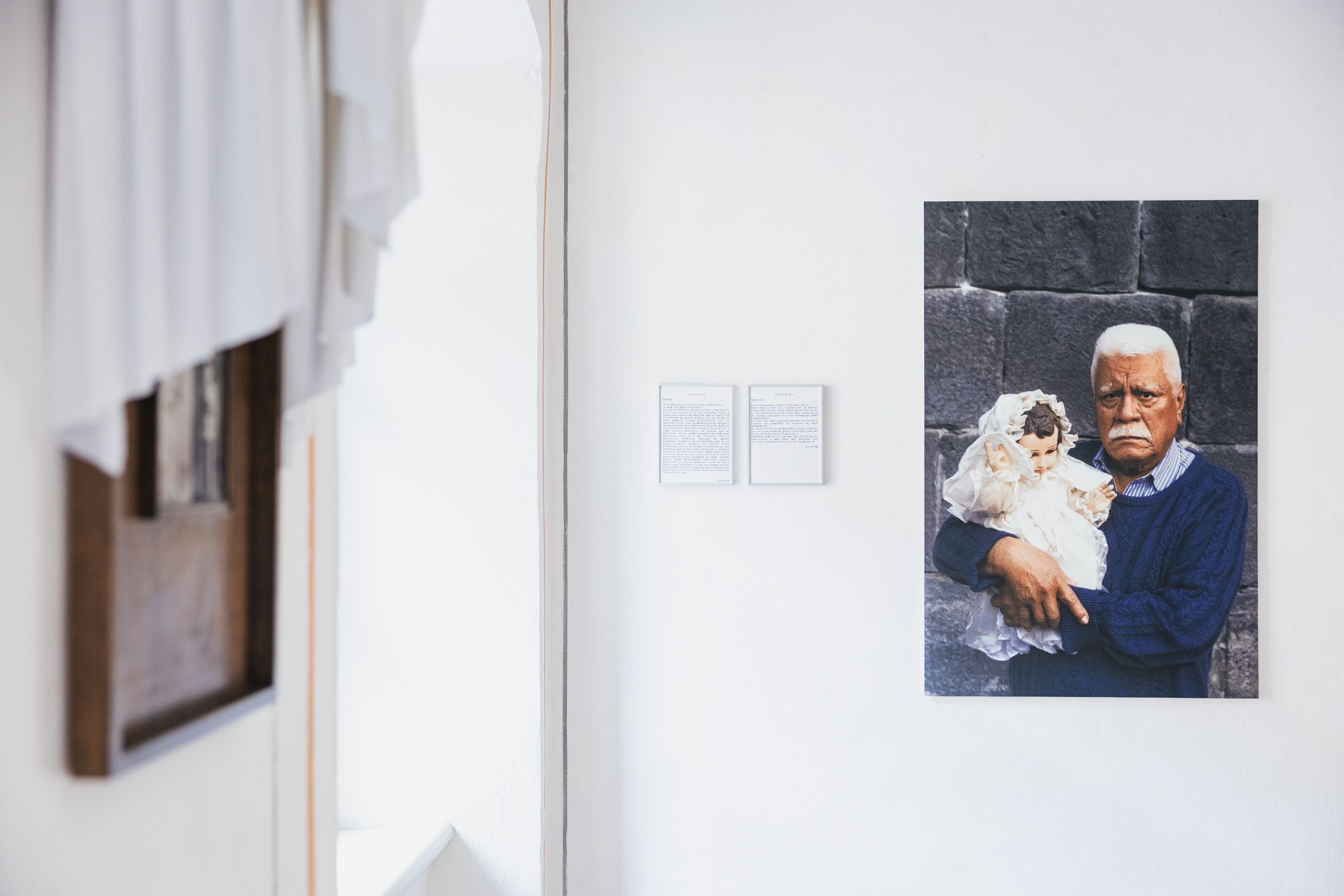
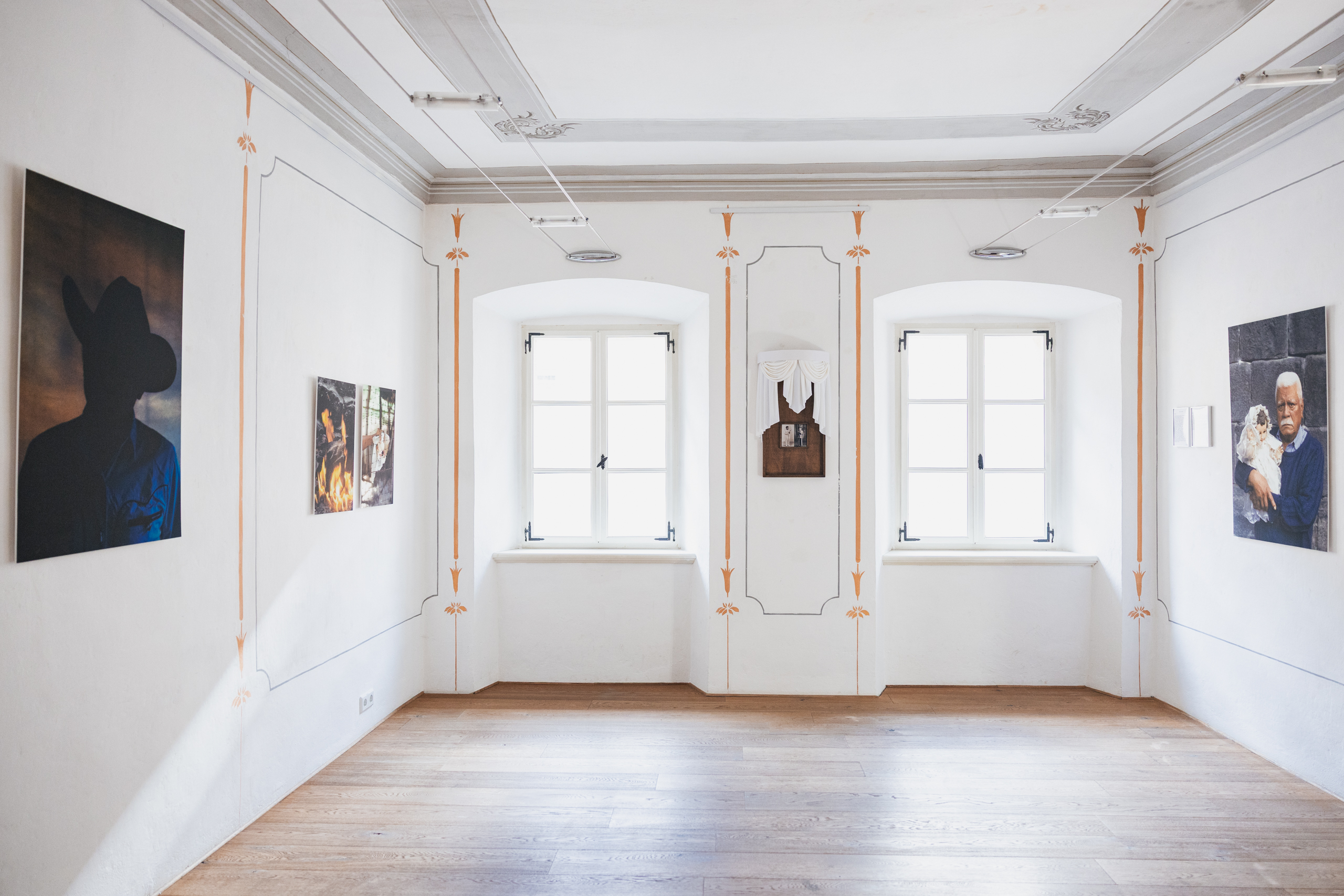
Exhibition set-up, photo: Katja Pokorn
Your work remains deeply rooted in Bolivian culture, landscapes and family histories while being developed across different geographical contexts. How did growing up in Cochabamba shape your visual imagination and your understanding of family, religion and gender?
I grew up in Cochabamba surrounded by the coexistence of the everyday and the mythical. Catholic imagery, Andean cosmologies, family and societal rituals were part of my visual vocabulary before I ever conceived of them as such. I think growing up with these different worlds existing side by side taught me to see reality as layered, and contradiction as something natural. Family was my first archive. It was where I learned about tenderness, beauty, power, desire and the roles we inherit, often without questioning them. Living abroad has made me more conscious of these images and codes. Distance allowed me to recognize how much Bolivia had shaped my way of seeing, and I was surprised and happy to find how naturally it continued to pour out of me.
Which artistic, literary or intellectual influences have been most important in the development of your visual language, and how have they shaped your approach to the relationship between personal history and collective experience?
My mother introduced me to literature and film, which became the foundation of how I see the world. I resonate with artists who blur the boundaries between documentary and fiction, and who understand the image as a constructed space rather than a transparent record. Lucrecia Martel, Agnès Varda and Michael Haneke have all shaped my visual language. Literature has probably influenced me just as much. I’m interested in writers like Miranda July, Chris Kraus, Annie Ernaux and Julio Cortázar who can move between intimacy and observation without explaining everything, and who understand that what is left unsaid can carry as much weight as what is stated. Like them, I begin with something personal, but I’m interested in where it stops belonging only to me. I’ve also been shaped by Bolivian storytellers and artisans, and by the women around me. I think of my practice as a form of weaving: bringing different voices, images and histories together.
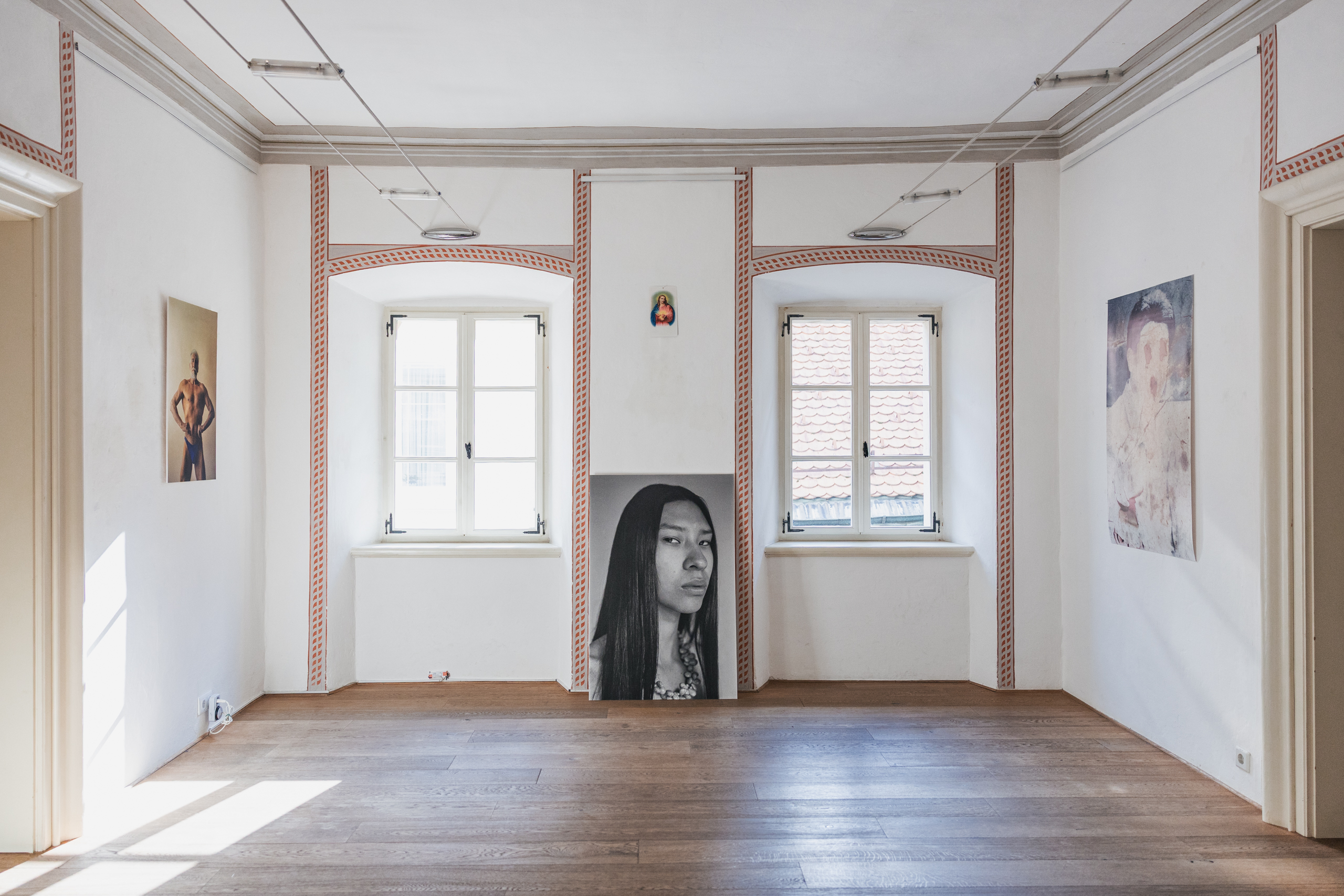
Exhibition set-up, photo: Katja Pokorn
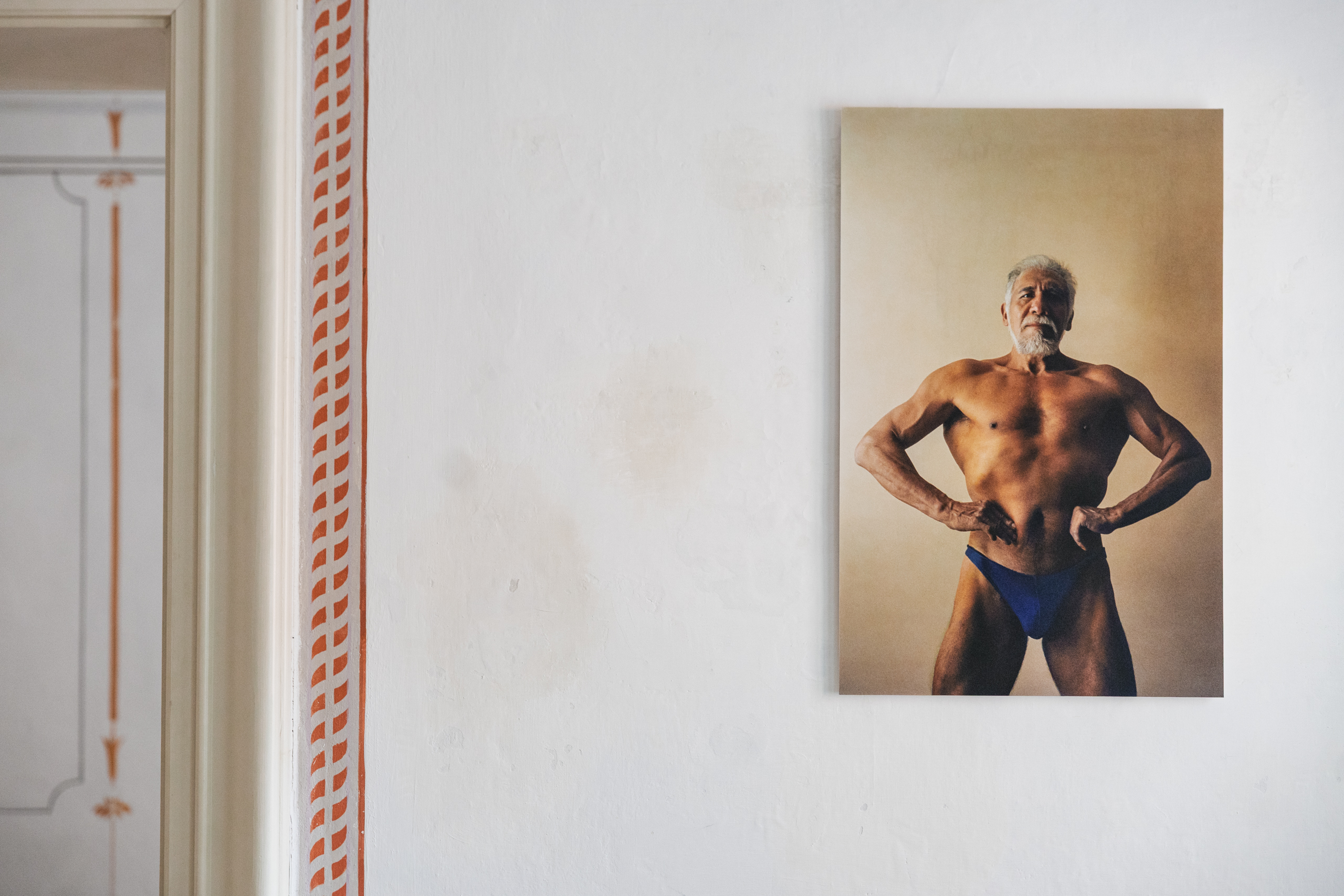
Exhibition set-up, photo: Katja Pokorn
You describe Padre as both a personal and political excavation of masculinity through a feminist lens. How has your position as a woman and a daughter shaped the questions you ask, as well as the limits and responsibilities you encounter while representing male experience?
Being a woman and a daughter means that I enter this subject from a particular distance. I’m not trying to speak on behalf of men, but to look at the systems and gestures I have witnessed from the other side of them. My own position is part of the work, and I don’t pretend otherwise. Even when people can’t articulate this distance they perceive it in the work. There’s friction, masks, questions and silence. There is also tenderness in the project. My father was a great one, which I know is rare and precious. My dad gave me the strength and courage I carry today. This contradiction keeps the project from becoming an accusation. It asks me to look at masculinity as something nuanced, full of contradictions and possibilities.
Padre began with letters written by your grandfather to your father and uncle. What did you recognize in this private correspondence that prompted you to develop a broader exploration of masculinity, fatherhood and emotional inheritance?
First, the letters reminded me of how complex the men in my family are. I had been focusing on women for a long time, but although men claim to be simple, my own experience has taught me that men are equally complicated creatures. My grandpa, for example, was a father, a fisherman, a diplomat, a political exile, a secret poet, a public cook with a quiet nature and a flammable character. The other thing that caught my attention was how much of their language revolved around what it meant to “be a man”: to protect, to provide, to be strong, to take responsibility for the family. Reading them, I started reflecting on how masculinity is taught and performed. These instructions were being passed from one generation to the next. I became interested in what happens to those teachings as they move through a family: what is accepted, what is resisted, what is transformed, and what continues to surface decades later. The letters became a kind of opening. From there, Padre grew into a wider excavation of the myths and behaviors surrounding the indoctrination of masculinity in Latin America.
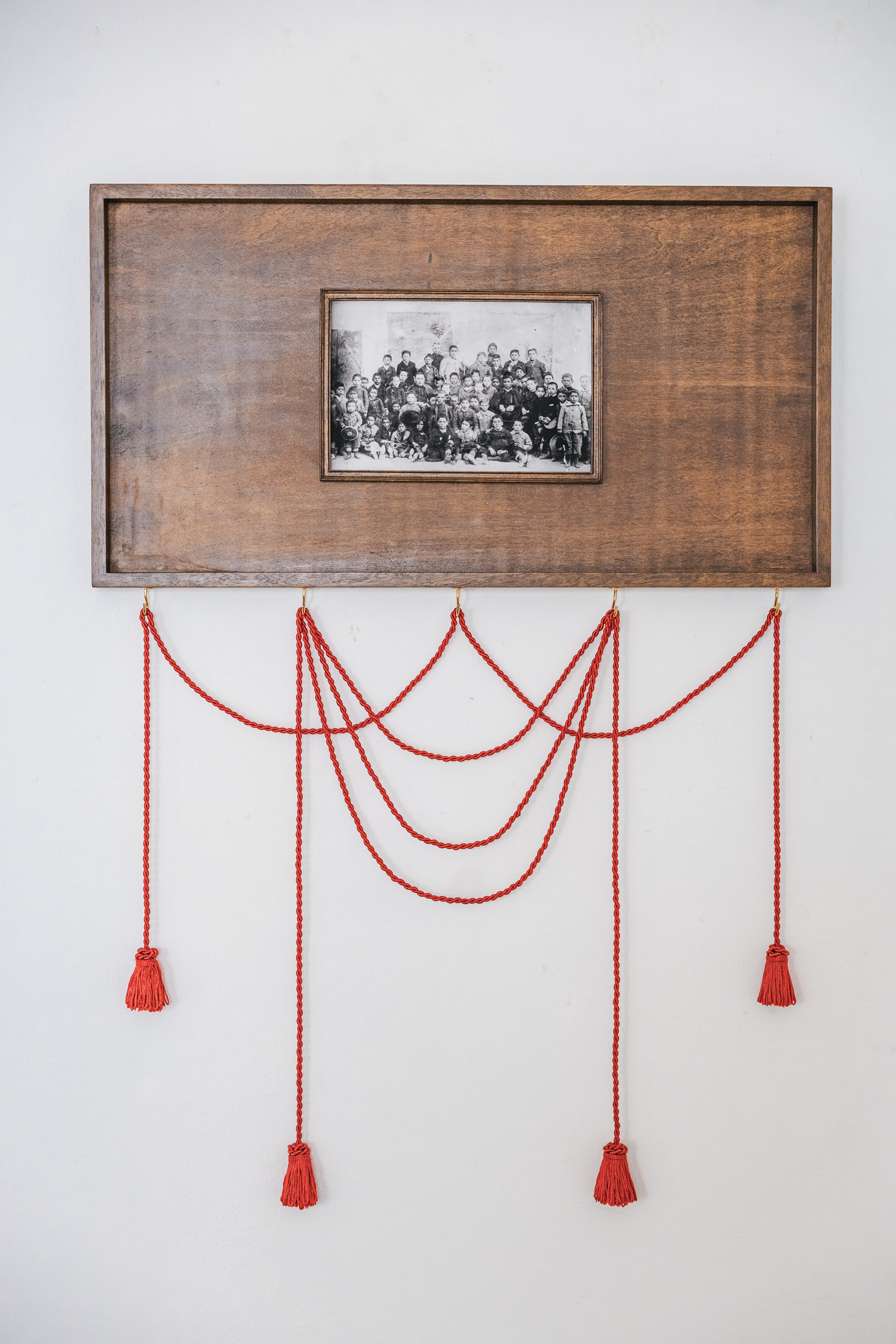
Exhibition set-up, photo: Katja Pokorn
Exhibition set-up, photo: Katja Pokorn
Photographing vulnerability requires a particular relationship with the person in front of the camera. How do you build trust with your sitters, and how much do their experiences and responses influence the final image?
For me, trust begins before the photograph. I spend time with people, listen, share, and let the relationship shape what happens in front of the camera. I may arrive with an idea, but I don’t want to impose a fixed image of who someone should be. The photograph becomes a negotiation between what I imagine and what they bring. With Padre, building trust with men has sometimes been more complicated. I’m conscious of how I carry myself, of being open without being inviting, and of making my boundaries clear. As a woman, my concern isn’t so much being misread because I’ve done something wrong, but being pursued simply because I’m one. That tension can affect the encounter, but I don’t see it as something that needs to disappear. Trust doesn’t always mean complete openness. Sometimes a friction remains, and the sitter’s response to that distance becomes part of the photograph. In that sense, their experience of me is as important to the image as my idea of them.
Padre follows your earlier project MADRE. How do these two bodies of work speak to one another, and how did moving from representations of femininity to the study of masculine archetypes transform your artistic process?
MADRE and Padre began from different questions, but they are connected by my interest in the ways gender is constructed through images, myths and inherited ideas. In MADRE, I was looking at the narrow representations of Bolivian femininity and playing with the distance between the woman I was expected to be and the many women I could imagine and the incredible women I knew. Padre turns the camera toward masculinity and asks what happens when we examine the ideals that men are taught to embody. Can the cracks allow for new forms to emerge or are we stuck in erosion ? The shift also changed my relationship to my own material. MADRE came from a very instinctive place. I made it through protest and through play. With Padre, I’ve become more investigative. I’m working with family archives, letters, objects, research and images, allowing the project to unfold through accumulation and association. The two projects remain independent, but they speak to each other across the gendered myths that shaped the world I grew up in.
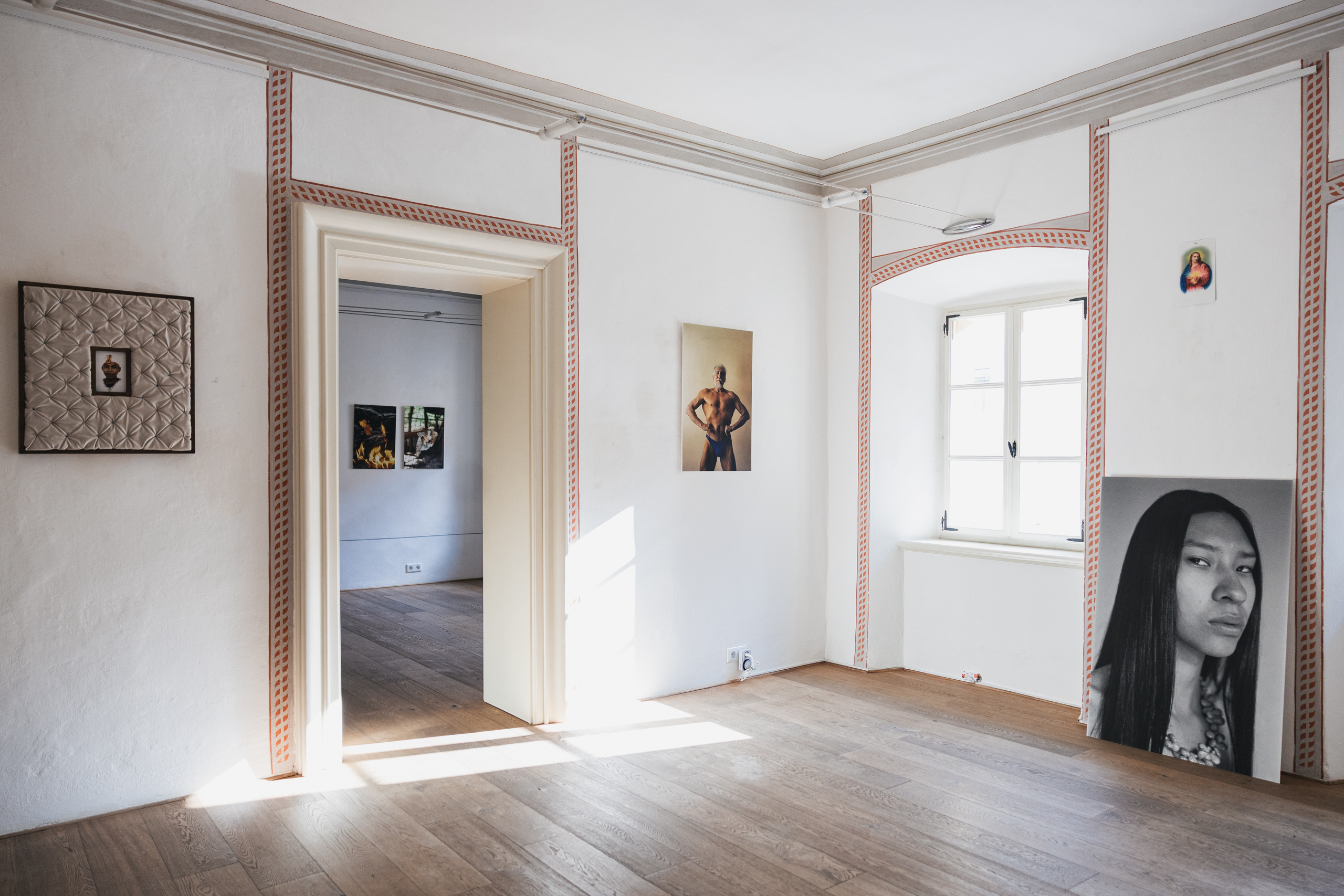
Exhibition set-up, photo: Katja Pokorn
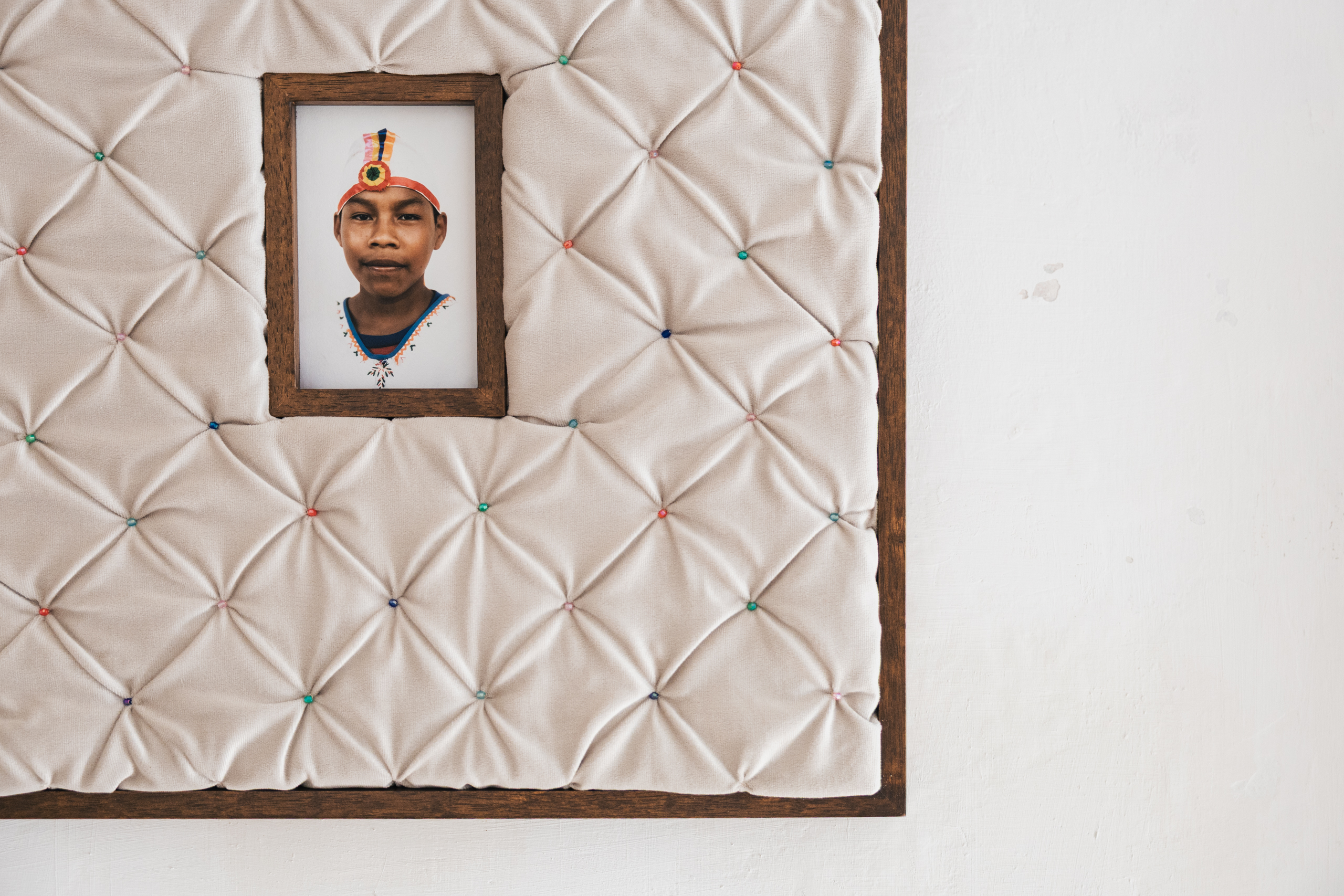
Exhibition set-up, photo: Katja Pokorn
One installation at Kranj Foto Fest places a small portrait of a boy, reminiscent of a school or identification photograph, inside a much larger wooden frame surrounded by soft, quilted fabric. Could you discuss the origins of this object and the role that framing, texture and softness play within the project?
Padre started with an object, so it feels natural for objects to become part of the exhibition. There are the letters, the toys “for boys” that I’m collecting, and now these structures that move the photographs closer to sculpture. I was lucky to collaborate with an Argentine designer, Catalina Alberici. From the beginning, we felt there was a real exchange between our practices, and an opportunity to push each other in new directions. All three pieces we made contain photographs of children. Padre is about how masculinity is transmitted, so I wanted these images to exist within something rigid, like a frame, while still being held by the softness of childhood, its innocence and malleability. Cata brought her own material explorations, including the quilt and the shiny beads. There is protection and play in them. There is also something meaningful in two women artists bringing that sensibility into a project about masculinity.
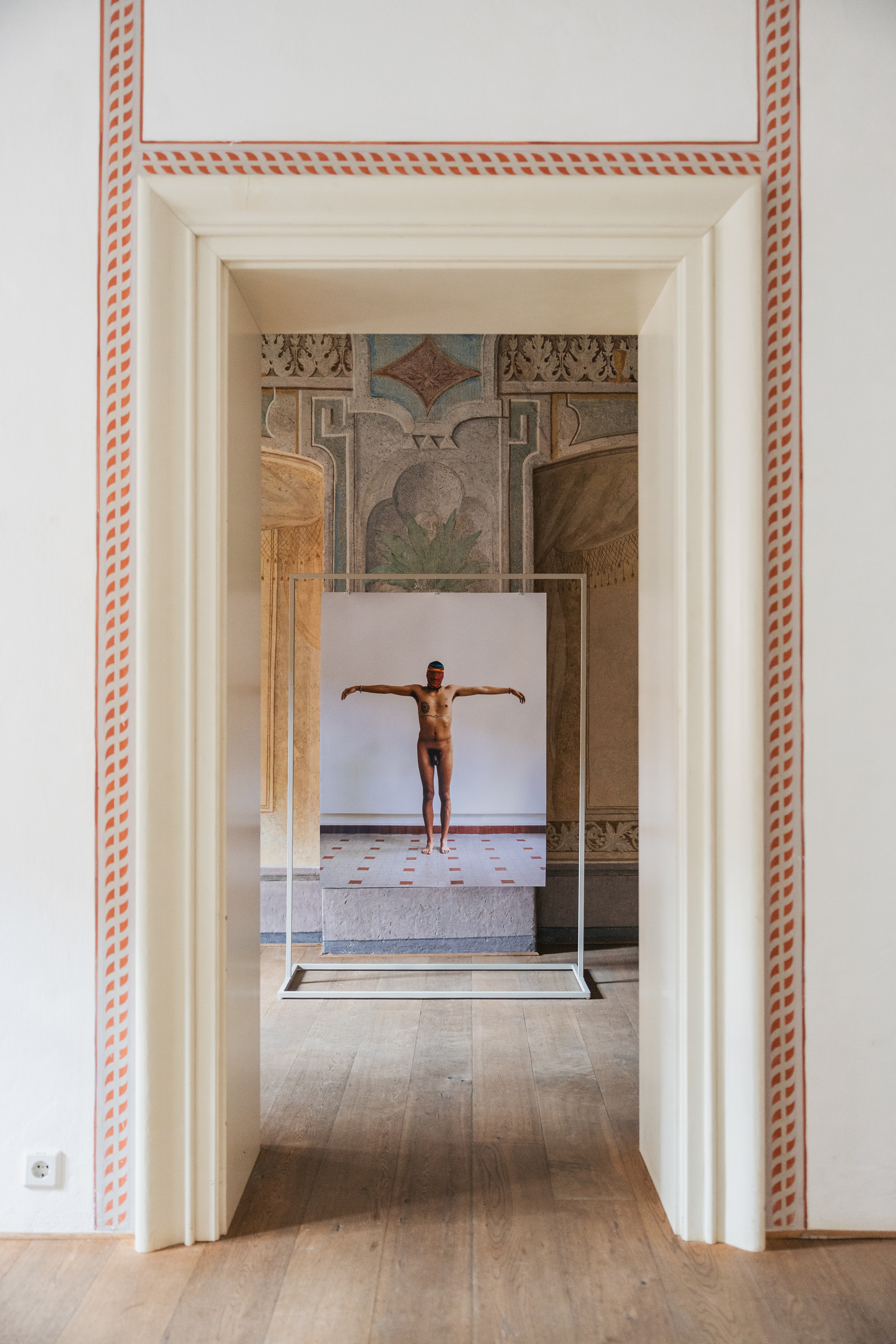
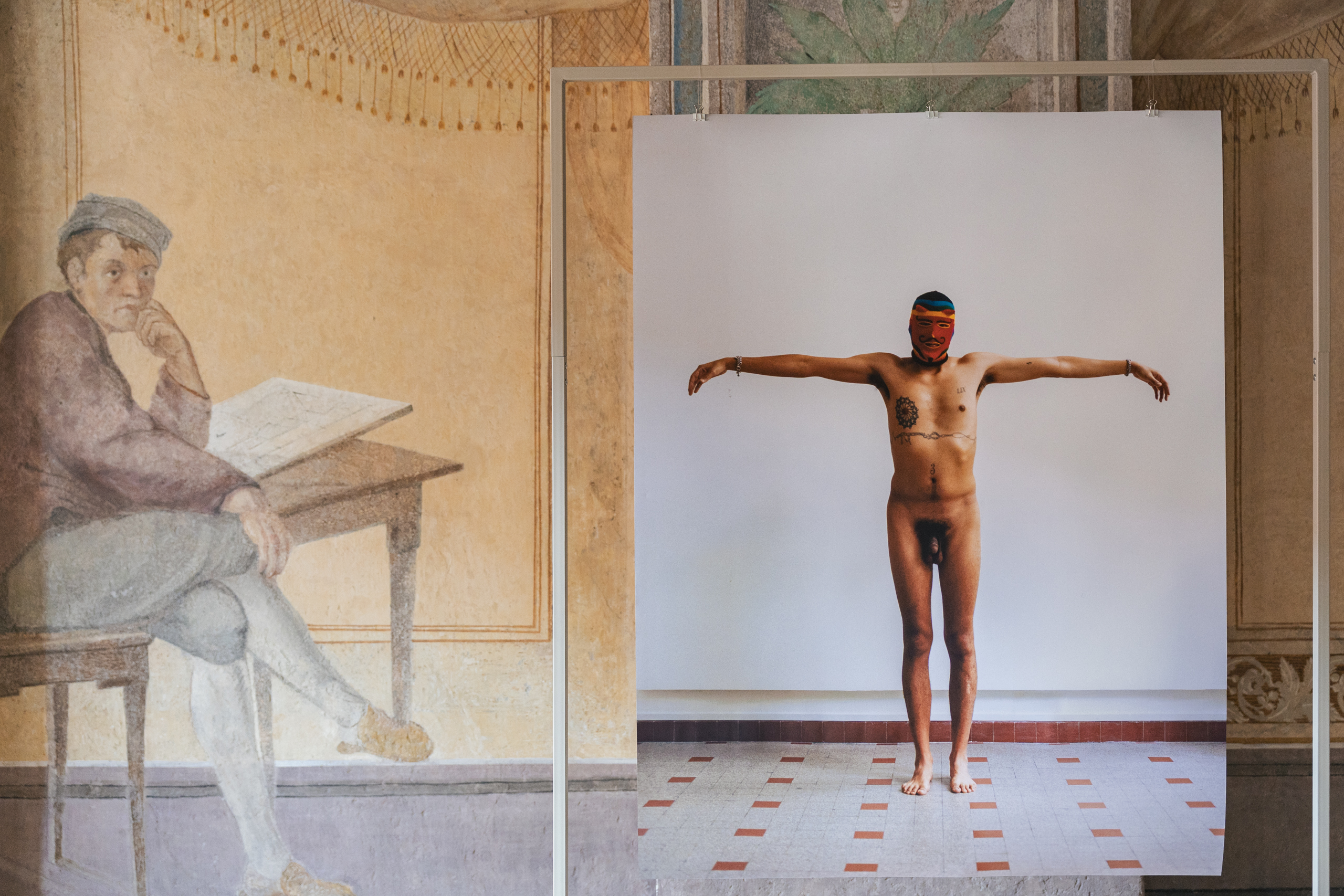
Another striking portrait depicts a nude man with outstretched arms and a covered face, evoking Christian iconography while holding vulnerability, exposure and anonymity in tension. How intentional is this religious reference, and what does it allow you to express about masculinity, sacrifice and the body?
Religious imagery tends to find its way into my work, even when I’m not consciously invoking it. In this case, Omar, my friend in the portrait, suggested the crucified pose. The red waq’ollo mask he wears brings in another layer, connecting the image to the syncretic nature of worship in Bolivia, where pre-Columbian beliefs and Christianity coexist. The waq’ollo is associated with the Qhapaq Qolla figures of Paucartambo, representing an Andean merchant. So the mask is not simply a way of hiding the face, but instead carries an identity and a history of its own. But even without knowing that reference, there is something unsettling about seeing a figure that resembles a demon occupying the position of Christ. That tension is at the heart of Padre: taking something familiar and shifting it just enough to make us question what we think we are looking at. Masks appear throughout Padre because I think about the ones men are asked to wear, the identities they perform in order to inhabit an idea of masculinity. Here, the body is completely exposed, yet the man is still not entirely naked. There is always something between him and the world. Perhaps that is where the image leads me: what does masculinity ask men to sacrifice to be considered men ?
Exhibition set-up, photo: Katja Pokorn
How did the architecture and atmosphere of Layer House influence the presentation and reception of Padre at Kranj Photo Fest?
I felt very lucky to have a space like Layer House for Padre. It’s a painter’s house in the centre of Kranj, with a sense of memory and accumulation already built into its walls. I’ve been thinking about how, for photographers, the work usually comes before the space, while many other artists make work with a space in mind from the beginning. With Padre, Layer House came first, which changed how I thought about the exhibition. I’m increasingly interested in moving beyond the two-dimensionality of the photograph, so together with Fernanda and Tereza from Kranj, we began thinking about how the architecture itself could become part of the work. Catalina was also able to design the frames and objects in response to the space. I particularly loved the floral orange wall linings in some of the rooms. They bring softness and a kind of domesticity against the violence and stillness of some of the photographs. And then there is Omar, naked, sitting among portraits of Slovenian men from another century. That juxtaposition creates a collision between different ideas of masculinity, across time and culture, that I could never have constructed inside the photograph itself.
Following the main award and your encounters with the festival audience, have any new interpretations or possible directions for the project emerged?
The audience is always gifting me new interpretations of my work. A festival is a beautiful place to share ideas, to see how a project is read and what emotions it evokes. It can also show me what is missing, or what I haven’t fully articulated yet. Something that has happened repeatedly with Padre is that mothers come to me afterwards and tell me the project feels important to them because they are raising sons. I find this particularly interesting because I don’t want to be a mother myself. Perhaps that gives me an even sharper sense of how difficult it is to imagine new ways of being when the structures we inherited are eroding and crumbling. Their responses have made me think about reimagining masculinity as a collective task. It can’t happen in isolation. It requires mothers, sons, fathers, daughters, women, men, queer people and everyone who participates in passing these ideas on. Another question that came up during the festival was biology. Those conversations reinforced something I’ve been thinking about throughout Padre: biology can’t account for the enormous differences between men. So much of what we understand as masculinity is learned, gender being a convention, not a prison.
Exhibition set-up, photo: Katja Pokorn
More information here.
We thank Kranj Foto Fest for providing the photographs of the exhibition installation.