Tena Starčević in conversaton with Calin Kruse, editor and publisher who runs the German independant publishing house dienacht Publishing in Leipzig.
dienacht Publishing: conversation with Calin Kruse
October 26, 2026
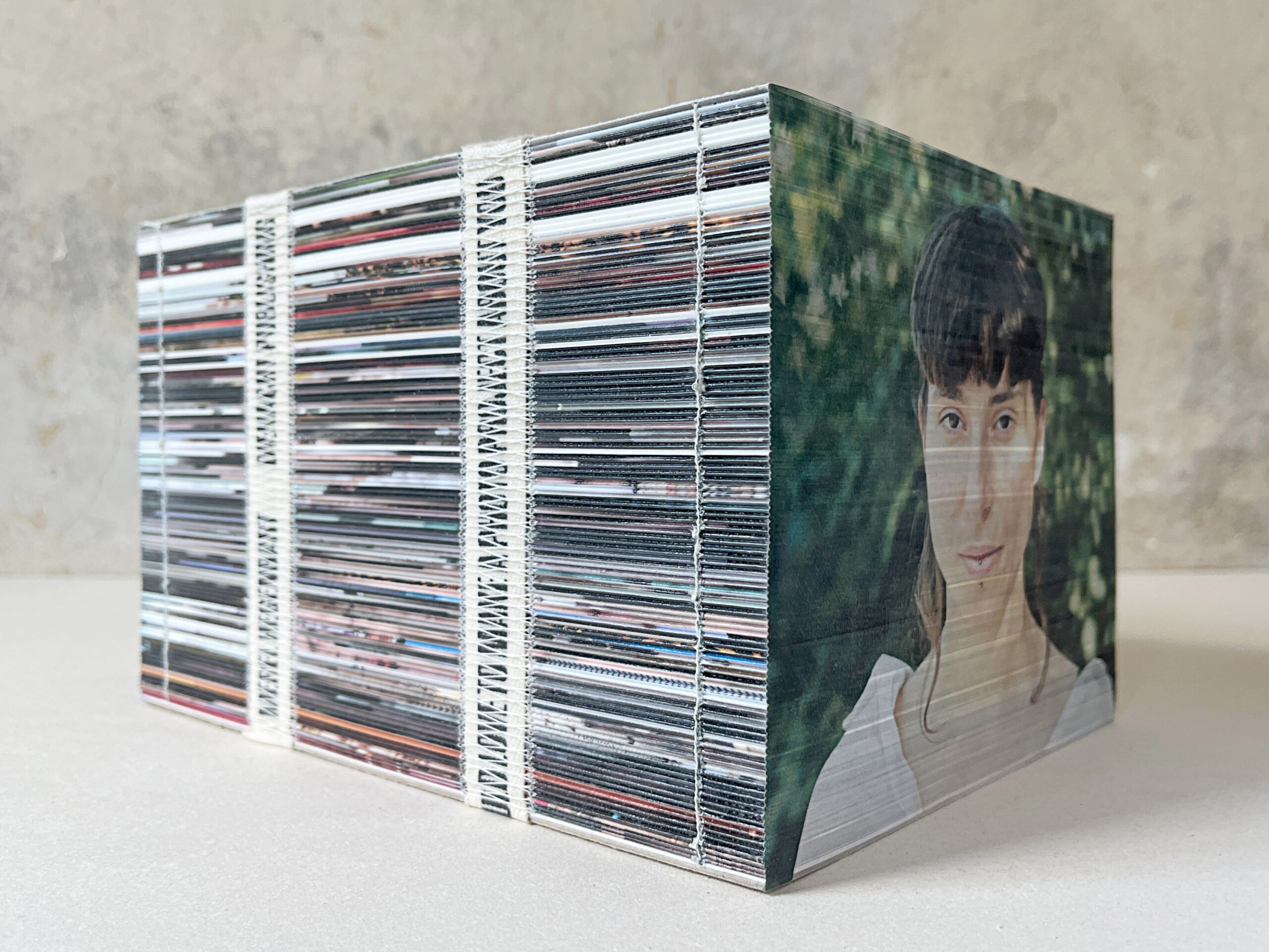
Merel Hegenbart, “I would love to make a photo project about you”, 2026
Germany has long been one of Europe’s strongest centres for photography and photobook culture. What has enabled this ecosystem to develop, and where do you see its strengths and vulnerabilities? Are there lessons that other countries might draw from the German experience?
Germany has built an infrastructure around the photobook rather than just a scene — that is the real difference. It has design schools with a strong tradition of photography and, increasingly in recent years, photobook-making, as well as several book fairs, including the Frankfurt Book Fair, the largest in the world. Photobooks are, of course, only a small part of it, but they are nevertheless present. The Kassel Photobook Festival served as an important meeting point for the photobook world, and hopefully the Leipzig Photobook Festival can now take on a similar role. There are also a good number of art book fairs, zine markets and photobook fairs. However, I wouldn’t describe the ecosystem as particularly resilient. Steidl recently faced bankruptcy, there are hardly any grants for publishing photobooks, and we have difficulty securing funding for the Leipzig Photobook Festival. Funding institutions have no category for the “photobook” and often lack an understanding of what a photobook is or can be. Nor do I think it is particularly helpful to advise other countries, since every ecosystem is different and has different needs. What matters, I think, is building an ecosystem, providing education and raising awareness of the medium — step by step.
Leipzig has become an increasingly important meeting point for the international photobook community. How has the city’s photography scene evolved in recent years, and what role have independent initiatives played in that development?
What has changed most is the openness of established institutions. When we started the Leipzig Photobook Festival in 2022 in collaboration with the GRASSI Museum of Applied Arts, and later continued it in partnership with HALLE 14 at the Baumwollspinnerei, it showed that an independent, artist-led initiative could work with established institutions on an equal footing rather than simply being absorbed by them. The GRASSI Museum also began building its own photobook collection. Last year, our dienacht association launched another initiative that is unique in Europe: 24FPS — Photography in Film. Once a month, the programme presents a film about photography or photographers — whether a documentary, biopic or feature film — at a local cinema. We often invite guests such as filmmakers and photographers to join us in person. Leipzig has also hosted the f/stop Festival for Photography for many years. The presence of established photography and photobook events encourages smaller initiatives to develop programmes of their own. As a result, the city now has a wide range of initiatives, both large and small, working with photography.

Leipzig Photobook Festival, exhibition, 2026, photo by: Walter Le Kon

Leipzig Photobook Festival, exhibition, 2026, photo by: Walter Le Kon
Each year, through festivals, workshops and portfolio reviews, you meet hundreds of photographers, publishers and designers. Looking at Europe as a whole, what trends are you currently observing in photobook practice?
Print quality continues to improve. Printers and manufacturers have discovered our small industry and now actively court publishers at fairs, which wasn’t the case fifteen years ago. I’m also seeing photobooks move away from presenting themselves as neutral objects. There are more unconventional bindings and unusual papers, and more books that actively engage with their own materiality rather than simply presenting images in a clean sequence. Thematically, there is a strong interest in power, fragility, protest and intimacy — in work that is political and personal at the same time. Europe, however, is not a single scene: a project from the Baltic states reads very differently from one from Southern Europe, both in its sensibility and its subject matter. What has changed most recently is whose work gets shown. Photobook cultures from across Africa, along with archives from beyond the established Western European canon, are finally gaining substantial visibility at European fairs and festivals — not as a side note, but as a central part of the programme.
Despite predictions that printed books would disappear, photobooks seem to be experiencing renewed momentum. Why do you think artists continue to choose the book as a medium in an increasingly digital culture?
Because a book is a finished argument. On a screen, an image is part of an infinite, reorderable stream. In a book, the sequence, the pacing and the relationship between one spread and the next are fixed — and the artist has complete control over them. A photobook allows you to create a rhythm, a beginning and an end, in a way that no feed can. There is also something almost stubborn about choosing an object that takes months to make and cannot be updated once it has been printed, within a culture built around endless revision. That resistance is part of its appeal to artists today.
Has the role of the photobook changed in the age of Instagram, AI-generated imagery and endless online circulation? What can a printed publication still offer that digital platforms cannot?
I don’t think its role has changed. I think it has become more appealing. It’s the same with photography festivals: you probably wouldn’t go to an exhibition featuring photos from Instagram, but you would go to an exhibition curated by a human. Regarding photobooks, you can’t fake the weight of a book in your hands or the time it took to sequence 200 pages. Online circulation is about volume and speed; the book is about depth and duration. I don’t think the photobook is competing with Instagram — it’s doing something Instagram structurally can’t do: holding a single, complete physical statement still long enough for you to actually sit with it.

Leipzig Photobook Festival, Talks, 2026, photo by: Walter Le Kon

Leipzig Photobook Festival, 2026, photo by: Walter Le Kon
Independent publishing is often described as a labour of love. From your perspective, what are the biggest challenges for small publishers today — financially, logistically and creatively?
Financially, paper and printing costs have gone up considerably in the last few years, and most of what we publish — the small, personal projects I care about most — brings in essentially no income; we do them because we want them to exist, not because they pay for themselves. Logistically, distribution is still the hardest part of this whole industry: getting books into the hands of people who’d actually want them, across borders, without the margins collapsing under shipping costs. And creatively, the challenge is protecting the time and attention each book needs — every project needs its own “language”, and that kind of close collaboration with an artist doesn’t scale. You can’t mass-produce the care a good photobook requires, which is exactly why small, independent publishers still matter.
Many festivals have become much more than exhibition platforms. The Leipzig Photobook Festival combines exhibitions, workshops, portfolio reviews, talks and a book fair. Why is it important to create these different points of entry for audiences?
Because not everyone comes to a photobook in the same way. Someone might walk into an exhibition out of curiosity and never buy a book; a photographer might come purely for a portfolio review and discover the book fair only by accident; a student might sit in on a talk and leave wanting to make their first dummy. If you only offer one format, you only reach one kind of visitor. Leipzig is deliberately unticketed and spread across exhibitions, talks, workshops, reviews and the fair itself because we want someone with no background in photobooks to be able to wander in off the street and find a way in, just as much as we want publishers and curators to find real professional value. As we say in our description, “We want to entertain, inspire and change the way people look at photobooks”. It’s also why we keep the fair free for visitors — it’s a fairer deal for the publishers exhibiting, and it keeps the whole thing from becoming a closed event for insiders.

Leipzig Photobook Festival, 2026, photo by: Walter Le Kon
Education seems to be at the core of your practice, not only through workshops but also through mentoring and long-term programmes. What do emerging photographers struggle with most when they begin thinking about books rather than individual images, and why do your workshops always end with participants producing a physical dummy?
Letting go. Almost everyone starts a book project while still attached to every strong individual image, and the hardest lesson is that a book isn’t a greatest-hits collection – it’s a sequence, and a sequence has its own logic. That sometimes means cutting a photograph you love because it doesn’t serve the rhythm. Editing and sequencing require a completely different set of skills from taking photographs in the first place. Finding the “language” of a project – is this a magazine feature, a book, an exhibition or an installation? – is something people often discover only by trying and failing with the wrong format first. This is also why making a physical dummy is so important. A book becomes tangible once it’s in your hands. On a screen or in a stack of prints, you can’t know whether a sequence works. Bind it – even roughly – and suddenly the pacing, the pairings and the weak spread you were hoping no one would notice all become obvious. Making a dummy forces a decision; it turns an idea into an object you can hold, flip through and examine to see whether it works or what might be missing. It’s a very good starting point.
Who do you see as the audience for photobooks today? Are photobooks still primarily circulating within specialist circles, or do you notice growing interest from broader audiences?
It is still, at its core, a specialist audience – collectors, other photographers, publishers, curators and students. But that circle has been widening steadily, partly because many festivals are deliberately free, and partly because the book as an object has a broader cultural appeal right now, extending beyond photography itself to people who appreciate well-made printed things. I wouldn’t say the photobook has broken into the mainstream yet, though.
Are there collectors in Germany who contact you directly because they are already familiar with your publications, or do most people discover your work through photobook festivals and other specialised events?
Both happen, and increasingly the two feed each other. There’s a small, loyal group of collectors who know the dienacht’s programme well enough to reach out directly when they hear that a new title is coming out. But most new relationships still start at festivals and fairs – someone sees the books on the table, talks to us in person, and that’s usually a far stronger way to build trust than any amount of online presence. Photobooks are a tactile medium; people want to hold the book before they commit to it, so face-to-face contact remains the main way new collectors find us.

Leipzig Photobook Festival, 2026, photo by: Walter Le Kon

Leipzig Photobook Festival, 2026, photo by: Walter Le Kon
Photobook festivals are flourishing across Europe. Do you see them as places for discovering books, building professional networks or perhaps even shaping the future of photobook practice itself?
All three, and I don’t think you can really separate them. Discovery happens through the exhibitions and the fair; networking happens through portfolio reviews, talks and informal conversations around the book tables – that’s often where a photographer meets the publisher who ends up making their first book. But festivals also shape the field simply through what gets selected, exhibited and awarded. What we choose to put in front of an audience – which themes, which regions, which voices – quietly sets an agenda for what photobook practice will look like going forward. That’s a responsibility I take seriously when programming.
If you could change one thing about the European photobook ecosystem – whether in publishing, funding, education or distribution – what would it be?
Distribution and funding for small publishers, specifically the ones without institutional backing. The actual economics of printing, storing and shipping small editions across Europe are still brutal for a one- or two-person publishing house. Some new EU regulations are not helping this at all. If there were more structural support – subsidised distribution networks, cross-border touring for exhibitions, translation and visibility funding for publishers working outside the usual German-French-British-Dutch axis – I think we’d see a lot more voices from Central, Eastern and South-Eastern Europe getting the reach they deserve.
From a broader historical perspective, what have been the dominant approaches to the art photobook in Germany? And how does the German tradition compare with that of your native Romania, whose photobook scene remains relatively little known to us?
In Germany, the tradition leans heavily on the monograph and on a strong documentary lineage – think of the influence of the Düsseldorf School, Bernd and Hilla Becher’s typologies, and the whole idea of the photobook as a serious, editorially rigorous single-author statement. Romania is a very different story: the photobook culture there is still genuinely young – mostly built in the last fifteen to twenty years by individual photographers and small, often self-published initiatives rather than by an established publishing industry.

Arko Datto, “Where do we go when the final wave hits”, 2026

Arko Datto, “Where do we go when the final wave hits”, 2026
The monumental book I would love to make a photo project about you by Merel Hegenbart has only just been published and is clearly a special edition. Who is such a book intended for, and how do you balance the need to preserve it with the desire to make it accessible to the public?
A book like this – hand-bound, 1,800 pages, fifty copies, each one requiring around eight hours for the binding alone – isn’t made for a general readership in the way a trade photobook is. It’s an art object first: something for collectors, institutions and libraries. That said, I don’t think “collector’s item” and “public audience” are opposites. As for preservation, I should actually say that something this size and this handmade needs to be treated like an artist’s book in an institutional collection. But what I really want to say is this: it’s still a book. People should be able to see and read it.
For Where do we go when the final wave hits by Indian photographer Arko Datto, you dipped the bottom section of each copy in muddy water, giving the edition a distinctive finish. How did you arrive at that decision, and how does this intervention relate to the subject of the book?
Arko documented the dwindling mangrove forests and rising water levels of the Sundarbans in India, where 300 million inhabitants of the delta experience the daily nightmare of climate change. Starting from the idea of rising water levels, the decision to place the photographs high on the page and dip the bottom section in muddy water came naturally. Some people who bought the book online wrote to me saying that it had arrived with water damage and that they would like an ‘undamaged’ copy.
What excites you more about book production: creating a printed edition that depends on the skills and expertise of others, or producing a handmade edition in which you retain control over every stage of the process?
That’s an easy one. When I don’t have to depend on anyone, it’s paradise. Especially when you’re making small print runs — like 50, 100 or 150 copies — it’s incredible how much you can actually do yourself.