As part of the “Regional Photo Focus” section, which explores themes and festival events from across the region, we bring you a conversation between Tena Starčević and artist Joel Jimenez Jara, whose work Glimmers, Feathers and Staring Skies is featured at this year’s Kranj Foto Fest.
Kranj Foto Fest: Conversation with Joel Jimenez Jara
September 21, 2026
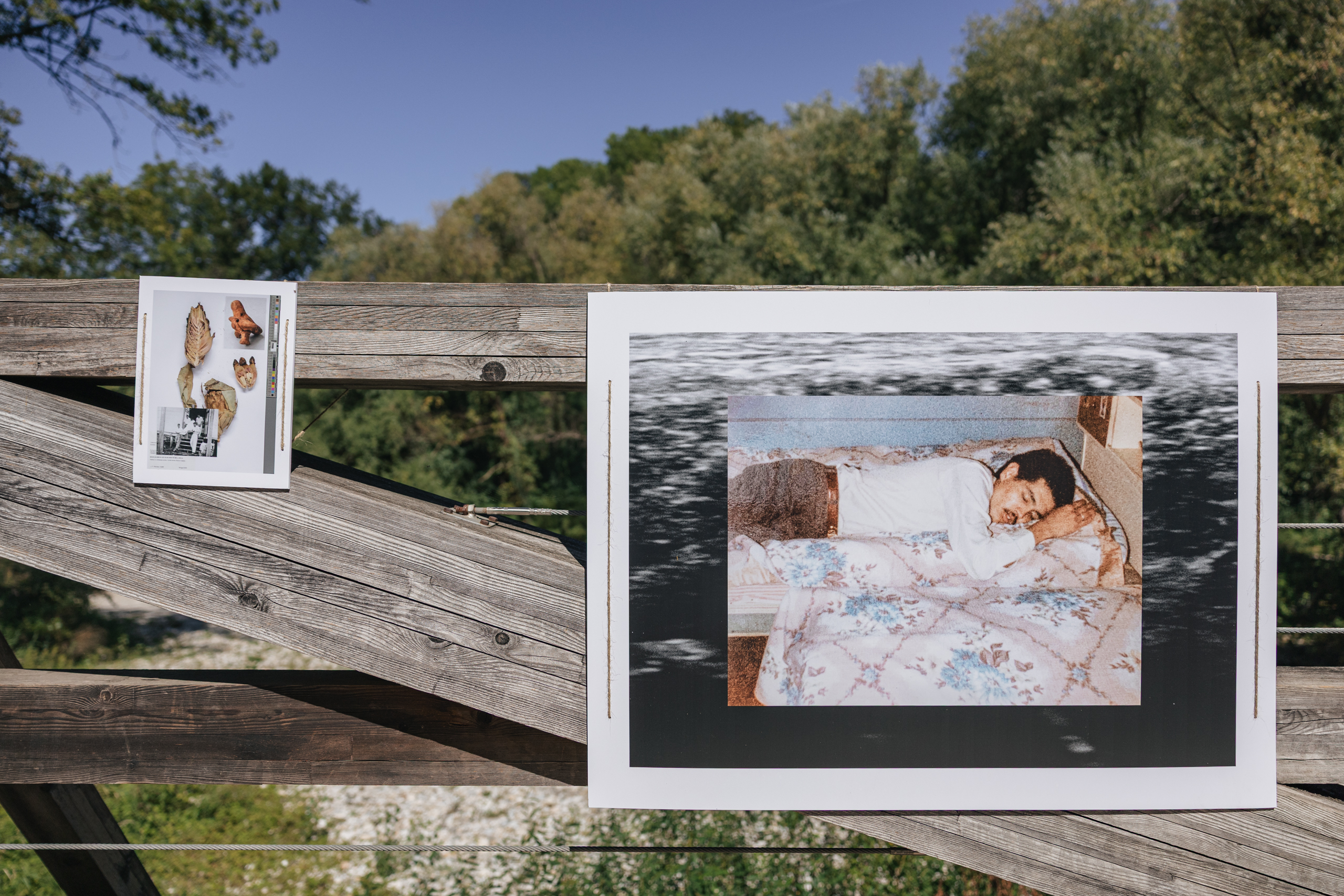
Exhibition set-up, “Glimmers, Feathers and Staring Skies”, Kranj Foto Fest 2027, photo: Katja Pokorn
For readers in Croatia who may be less familiar with contemporary photography in Costa Rica, how would you describe the context in which your practice first developed? Which local traditions, institutions or debates shaped your early understanding of photography?
I think the starting point for answering this question is to mention that I migrated from Costa Rica to Europe seven years ago. The majority of my artistic practice developed after I had already moved, specifically to Spain, and that transition became an important turning point for me, both personally and artistically. It made me much more conscious of how these two dimensions of my life continuously intertwine and shape the way I understand my practice. Before moving to Europe, however, I studied photography in Costa Rica. The program I attended approached photography quite broadly, encompassing both artistic and commercial practices. In retrospect, the scope could sometimes feel quite general, but I also understand it within the local context in which I was studying. There was—and still is—a relatively limited institutional and economic infrastructure for sustaining an artistic practice, particularly in photography, with fewer grants, residencies, and forms of support than exist in many European contexts.
What interests me most when I look back at that education is the photographic canon through which we were primarily taught to understand the medium. Much of the curriculum was informed by photographers from Europe and the United States. There were some courses dedicated to Latin American and Costa Rican photography, but these tended to approach them primarily from a historical perspective rather than as part of an ongoing, living field of research into what was being produced locally. I don’t necessarily see this as something unique to photography in Costa Rica. It reflects broader structures through which visual literacy has historically been constructed, where certain photographic histories and ways of seeing are positioned as universal while others become peripheral, regional, or supplementary. Coming from that environment, and later migrating to Europe, made me increasingly aware of the relationship between photography, geography, and power. I began to question who establishes the narratives through which we understand history, whose images become part of a canon, and how ideas of otherness are produced through particular visual systems.
In that sense, migration became an important catalyst for my practice. Being physically removed from Costa Rica created a distance that allowed me to look back at the place I came from while simultaneously questioning the visual and historical frameworks through which I had learned to understand it. My practice gradually developed from that tension: a way of questioning the medium, the archive, and the historical narrator while trying to understand my own position within the histories and territories I investigate. So although much of my practice was developed in Europe, I think Costa Rica remains an important underlying condition of how I see. The experience of coming from a context that was often represented through external photographic frameworks, and then finding myself inside many of those frameworks as a migrant, has made questions of perspective, power, belonging, and representation central to my work.
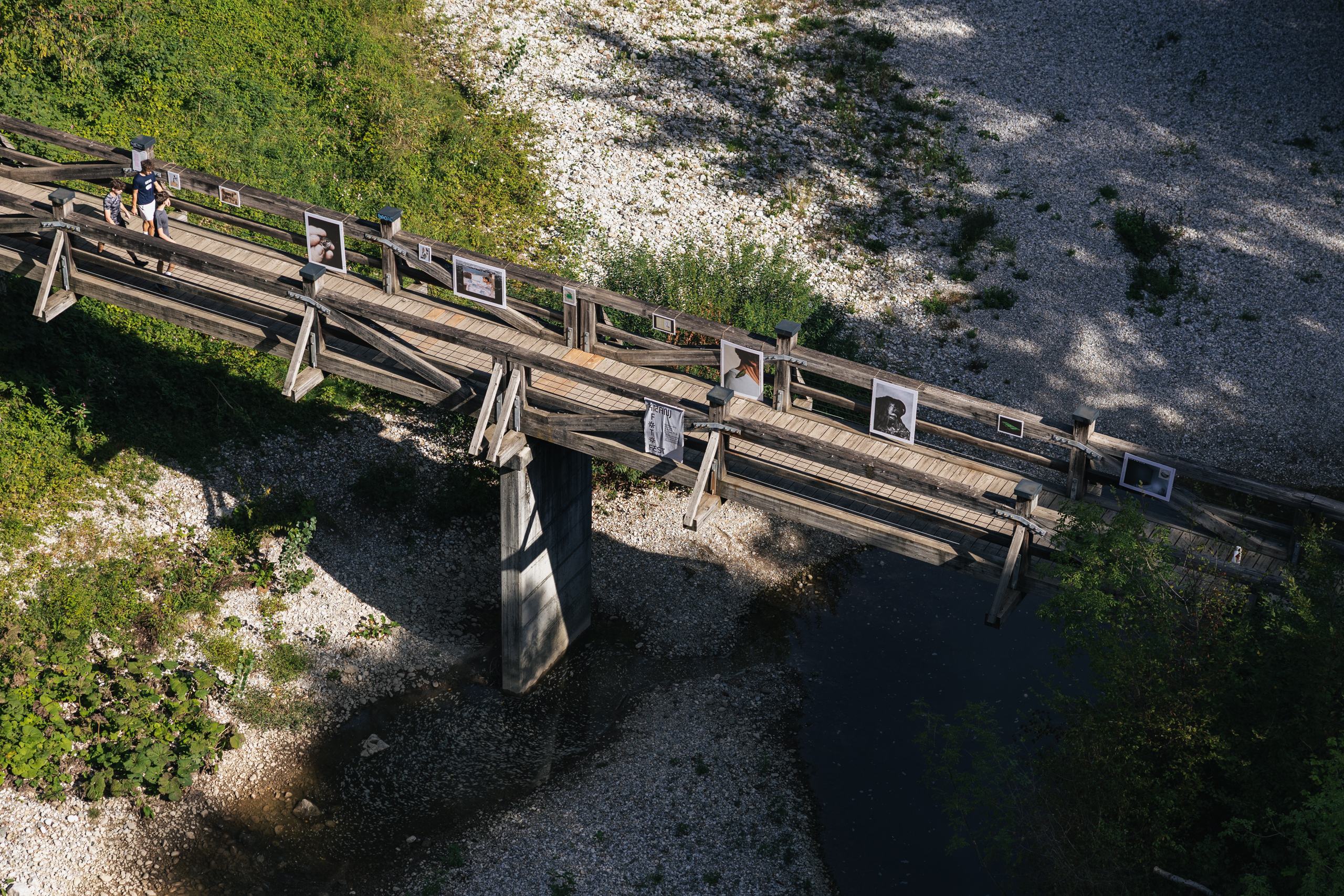
Exhibition set-up, “Glimmers, Feathers and Staring Skies”, Kranj Foto Fest 2027, photo: Katja Pokorn
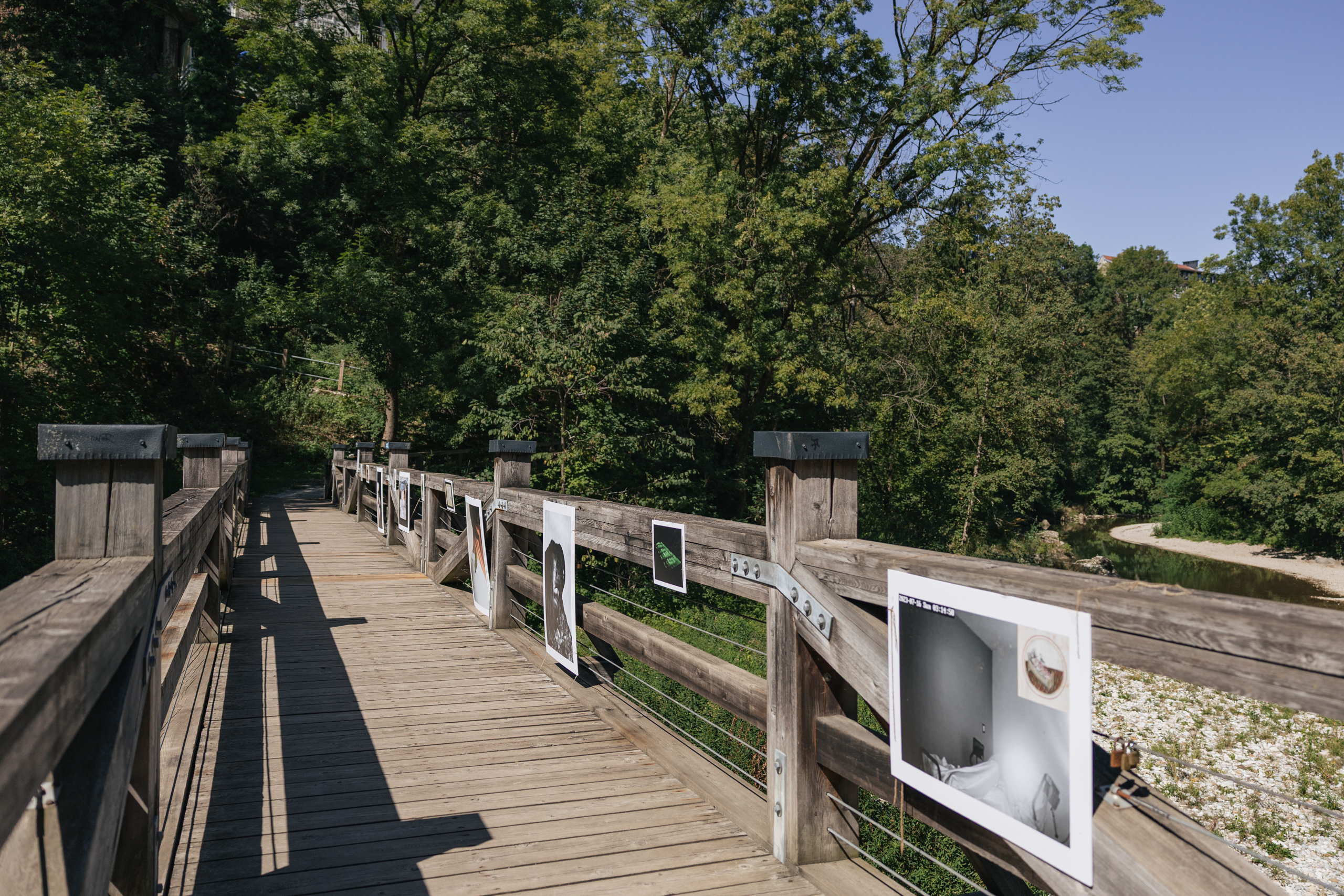
Exhibition set-up, “Glimmers, Feathers and Staring Skies”, Kranj Foto Fest 2027, photo: Katja Pokorn
You were born in Costa Rica and are now based in Madrid. How has living across different geographical and cultural contexts changed your relationship with home, distance and the histories you choose to explore?
I think migration produces a form of temporal, spatial, and emotional displacement. Rather than trying to correct that displacement or return to a single sense of belonging, my experience has been about inhabiting the in-between: an intermediate space in which different places, histories, and temporalities coexist within my embodied experience. Interestingly, even before moving to Europe, I had already begun instinctively working with subjects that reflected some form of this condition. I was drawn to territories, identities, and histories that seemed to exist in a state of transition, where the present was never entirely separated from what had happened before and where the future remained uncertain. Looking back, I recognize that I was already responding to a sense of instability or movement that I would later experience much more directly through migration.
After moving, distance became both a physical reality and a conceptual tool. I began thinking about what it means to be separated from a place and how images might allow me to establish a different kind of relationship with something that is geographically or temporally distant. Working with archives became particularly important in this sense. Reworking and activating archival images became a way of negotiating distance, not by eliminating it, but by acknowledging the gap and finding ways to inhabit it. This also changed my understanding of home. Home became less of a fixed geographical location and more of a network of relationships, memories, absences, and histories that I could carry with me. I think this became particularly clear after my father’s death. His death brought me back, emotionally and intellectually, to questions of family, grief, memory, and my relationship with the country where I was born. Being away from Costa Rica made that relationship feel simultaneously more distant and more intimate. The hummingbird gradually became a kind of overarching figure through which these concerns could converge. It allowed me to think about migration, absence, return, death, and belonging simultaneously, while also connecting the personal with broader cultural and historical questions. The bird moves between territories, but it also exists between different systems of knowledge: scientific and mythological, earthly and spiritual, visible and invisible.
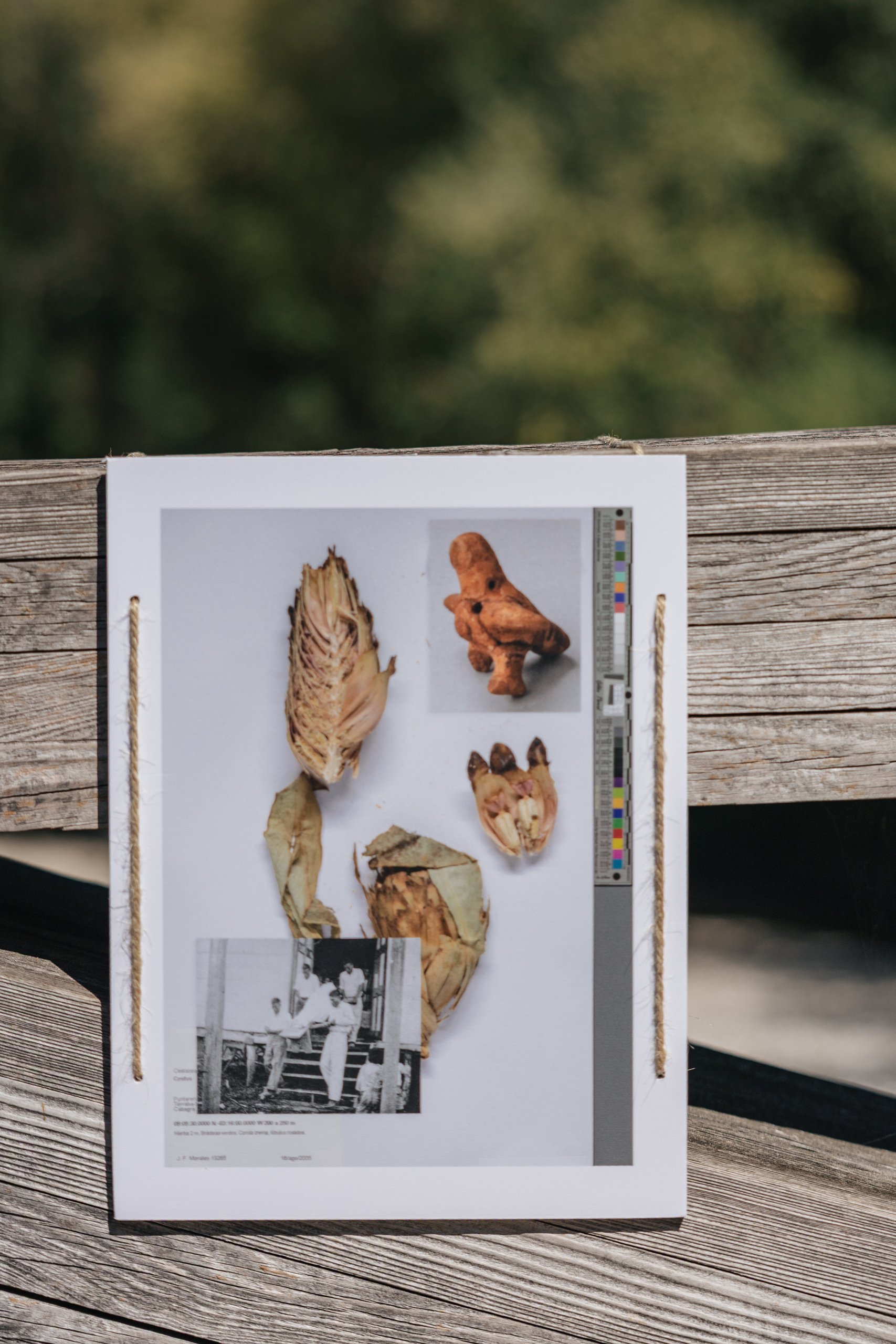
Exhibition set-up, “Glimmers, Feathers and Staring Skies”, Kranj Foto Fest 2027, photo: Katja Pokorn
Your practice moves across photography, film, sound and installation. What determines the form a particular project will take, and how has working with duration, movement and sound changed the way you think about the photographic image?
As my practice has evolved, alongside the research I have been developing, I have become increasingly interested in ideas of intersection and interrelation, both within the research process and in the way a project ultimately takes form. I believe in approaching the work relationally, which means understanding the possibilities and limitations of each medium and considering how different forms can establish networks between one another. Rather than deciding beforehand that a project should be photographic, cinematic, sculptural, or sonic, I try to understand what form feels most truthful to the experience and questions that emerge through the research. In that sense, I try to follow the paths that develop through the process. Sometimes this means an image becoming a textile, a video or a sound becoming an installation, or several mediums existing together within a space to create a more sensorial environment that the viewer can move through. I am interested in hybridization not simply as a combination of mediums, but as a way of allowing different forms of knowledge and perception to coexist within the same work.
Working with film has also changed the way I think about the photographic image, particularly my understanding of the frame and what exists beyond it. Film makes duration and movement unavoidable, and this has made me increasingly attentive to everything that a still image leaves outside its borders. For me, what lies beyond the photographic frame can become a space of speculation, imagination, and invention. At the same time, I have come to think of the still image itself as something much more dynamic than its apparent stillness suggests. A photograph contains traces of movement, but its meaning also shifts according to the time, place, sequence, and context in which it is encountered. It can exist within an archive, a book, a wall, an installation, or alongside sound and moving images, and each situation activates different relationships within it. So, working with duration, movement, and sound has not made me think of photography as a static medium that I need to move beyond. Instead, it has made me understand the photographic image as something porous and shape-shifting, whose possibilities extend beyond the frame and beyond the moment in which it was made.
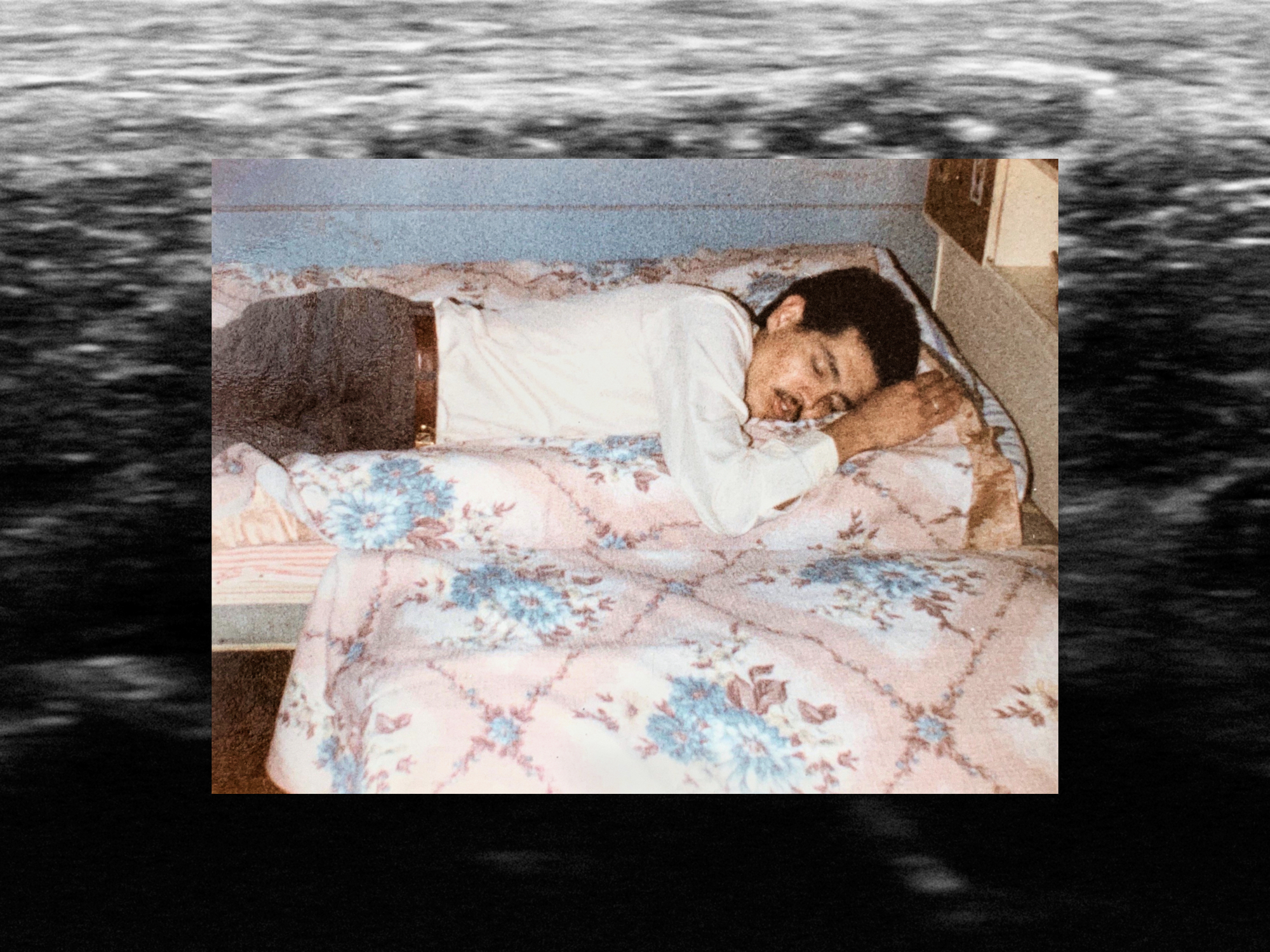
From the project “Glimmers, Feathers and Staring Skies”
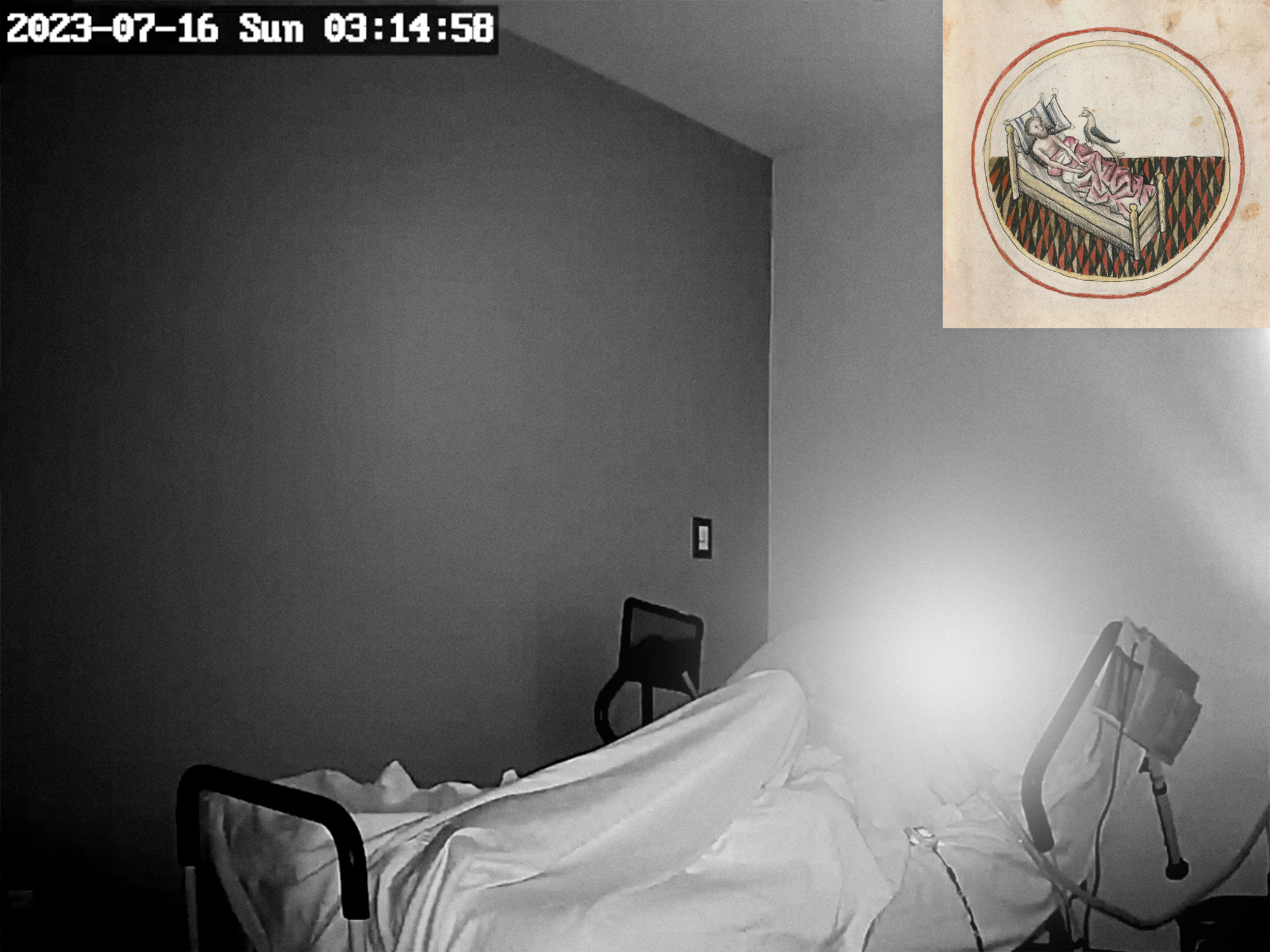
From the project “Glimmers, Feathers and Staring Skies”
Your statement describes the project Glimmers, Feathers and Staring Skies as a practice of care shaped through interspecies relationships. What does such care mean to you in concrete, lived terms, and how has the relationship between your father and the hummingbird expanded your understanding of who can carry or preserve memory?
I understand care as a practice of nurturing relationships, mending wounds, and being present. In concrete terms, it means trying to establish a relationship with the hummingbird through attention and respect, rather than approaching it simply as an object of representation or study. I think of the hummingbird as a being that carries forms of knowledge and ways of perceiving the world that are not necessarily accessible to us through human language. Paying attention to it therefore requires a certain degree of humility: observing, listening, and asking what kinds of stories or forms of knowledge might already exist within that relationship, rather than assuming that I am the one who has to give the bird meaning. This is particularly important to me because of the long history of the hummingbird as an object of scientific observation and collection. Humans have often approached the bird as a specimen through which to classify and understand the natural world, extracting information in order to construct systems of knowledge and control. The hummingbird was also constructed through ideas of otherness and difference within colonial and scientific cultures that captured, killed, classified, and displayed these birds. This history resonates with broader processes through which people, objects, and territories in Latin America were similarly collected, classified, and placed within hierarchical systems of knowledge.
My intention in this project is therefore to reflect with the hummingbird, rather than simply reflect on it. I want to place it as a protagonist of the story, alongside my father and his experience, rather than using the bird as a metaphor that ultimately serves a human narrative. Bringing the human and the more-than-human into dialogue allows me to ask how different forms of life might relate to and care for one another, even when that relationship cannot be reduced to a shared language. This also expands my understanding of memory. I have traditionally thought of memory as something carried by people, photographs, archives, or objects. Through the hummingbird, I have begun to think about memory as something that can also exist through relationships between species, environments, bodies, and forms of life. The hummingbird does not need to remember in the same way that I do for its presence to participate in a history. Through practices of care, I therefore try to create conditions in which these different forms of knowledge can encounter one another. The aim is not to speak for the natural world, but to become more attentive to the possibility that it is already speaking, carrying, and remembering in ways that exceed our systems of understanding.
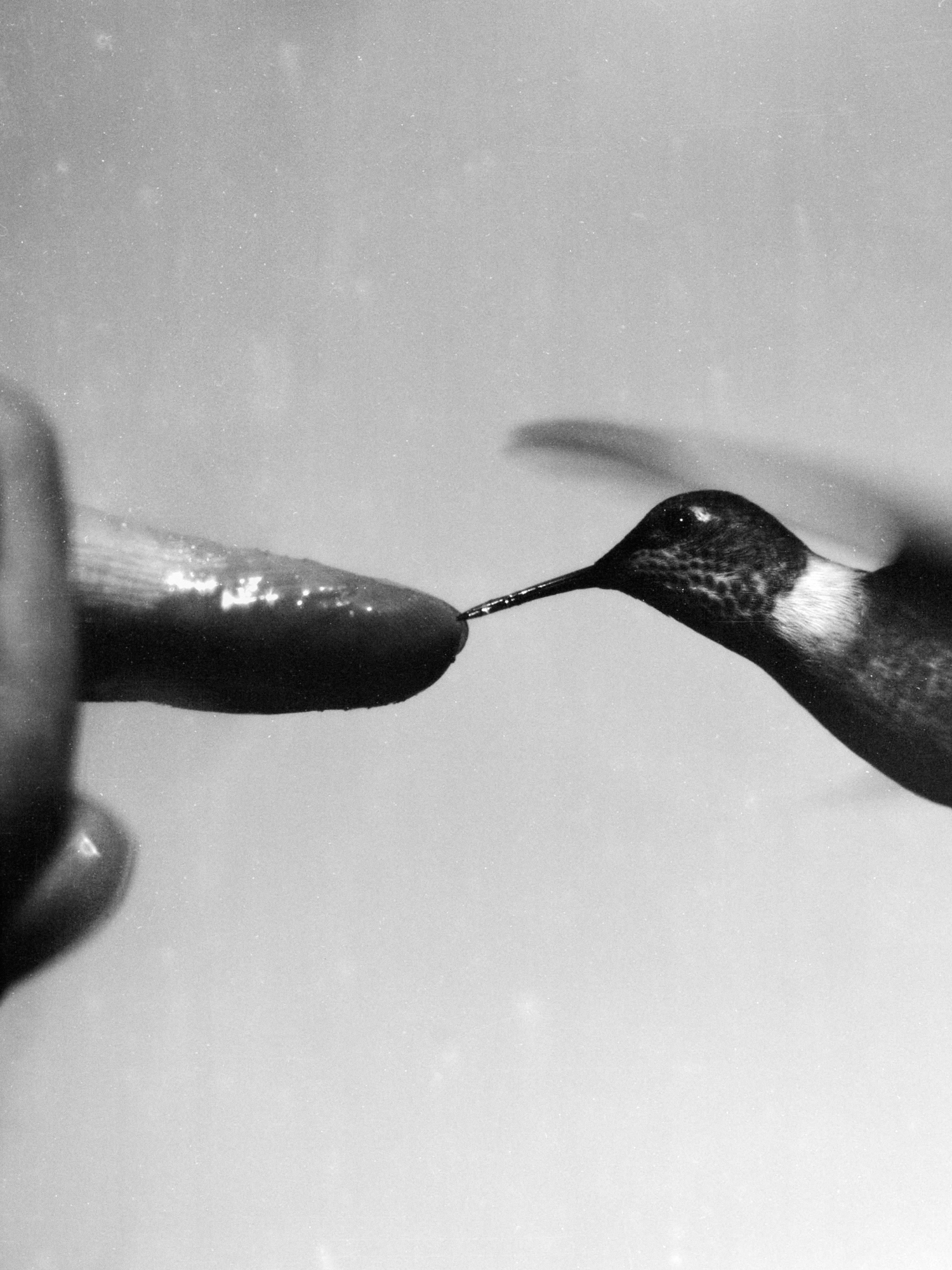
From the project “Glimmers, Feathers and Staring Skies”
Time is one of photography’s central concerns. How does the hummingbird’s ability to hover and fly backwards allow you to connect photographic time with the non-linear experience of migration and grief?
I find the hummingbird’s movement particularly powerful because it allows me to think simultaneously about human experiences of time and about the photographic medium. When the hummingbird hovers, it appears almost completely static. Yet that apparent stillness is only possible because of the speed of its wings, which exceeds the limits of our perception. Its ability to suspend itself, and to inhabit a temporality that does not necessarily correspond to our progressive understanding of time, makes me think about other forms of temporal experience that exist outside the rhythms imposed by productivity, efficiency, and capitalist time. Its ability to fly backwards also became important to me in relation to grief. Grief is not a linear movement from one state to another. It involves inhabiting multiple temporalities simultaneously: being alive and present while also returning constantly to memory, nostalgia, longing, and what has been lost. In that sense, hovering and moving backwards become ways of thinking about the experience of being suspended between presence and absence.
Migration has a similar quality. Although it is often understood primarily as a movement from one place to another, my own experience of migration has been much less linear. It involves moving forward while constantly returning, remembering, comparing, and carrying places and histories with you. You can be physically present somewhere while remaining emotionally and imaginatively connected to another place. The hummingbird also allows me to think about these questions through the limitations and possibilities of photography itself. I am interested in the tension between a device that attempts to capture an instant and a bird whose speed makes it difficult to grasp visually. There is something almost contradictory in the encounter between the camera’s desire to arrest movement and a body whose movement constantly exceeds our perception.
This also brings me back to the historical relationship between photography and scientific observation. The camera has often functioned as a tool for capturing, measuring, classifying, and producing knowledge about bodies that were considered objects of study. Even the language of “capture” carries a particular history when we think about photography alongside the collection and classification of animals. Rather than simply trying to overcome that limitation and produce a more accurate image of the hummingbird, I want to remain within that tension. I am interested in what happens when the relationship between the camera and the bird shifts from capture toward exchange, speculation, and perception. The hummingbird does not simply become an image of movement; it becomes a way of questioning what the camera can perceive, what it cannot grasp, and what other forms of time might exist beyond the photographic frame.
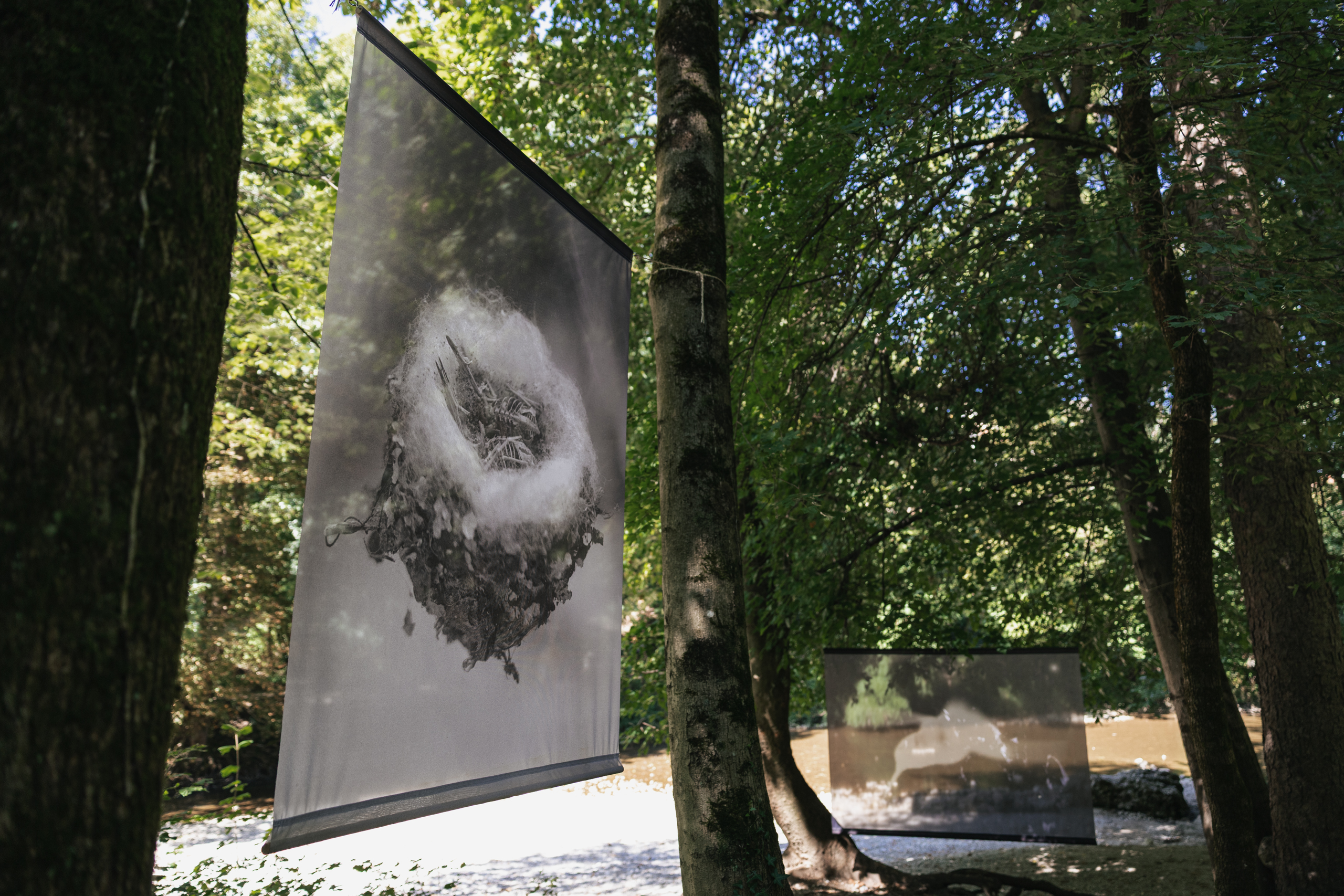
Exhibition set-up, “Glimmers, Feathers and Staring Skies”, Kranj Foto Fest 2027, photo: Katja Pokorn
The hummingbird entered the project through a story told by your mother and a Costa Rican folk belief influenced by the cosmology of the Indigenous Boruca community. How did you approach the relationship between family memory, popular belief and Indigenous knowledge? What responsibilities accompanied bringing these different forms of knowledge into the same work?
For me, the main responsibility is to avoid treating these forms of knowledge as material that I can simply extract, incorporate, and transform into an artistic narrative. I am interested instead in what happens when different forms of knowledge enter into relation, and in how they can activate new networks of grieving, healing, and care within myself, my family, my relationship with the hummingbird, and potentially with the viewer.
The project begins with a very intimate story: my mother’s experience of seeing the hummingbird after my father’s death, and the belief that hummingbirds can carry the souls of the dead. From there, the research expands into broader cultural and historical territories. It is important for me, however, to recognize that these territories are not mine to speak for. I can approach them from my own situated position, but I cannot claim to represent Indigenous knowledge or speak on behalf of the Boruca community. This distinction has become an important part of the way I think about the project. I am not trying to establish whether the hummingbird carrying the soul of the dead is objectively true or false. Instead, I am interested in what this belief makes possible as a way of relating to death, memory, the natural world, and one another. Its significance for me lies not in proving a supernatural claim, but in understanding how a particular way of seeing can create relationships and forms of care that might otherwise remain invisible within dominant systems of knowledge.
I also want to be transparent about the fact that the work itself is an act of interpretation. The personal, the intimate, and the familial are not presented as untouched evidence. Through research, archival intervention, image-making, and narrative construction, I actively shape the material. Making that agency visible is important to me because I do not want the work to reproduce the authority traditionally associated with documentary photography, where the artist can appear to simply reveal an objective truth. This is also why I am interested in questioning who has the authority to define what counts as truth, knowledge, or a meaningful experience. Different systems of knowledge can coexist without necessarily being reduced to one another. For me, creating that space of coexistence is part of the ethical responsibility of the work.
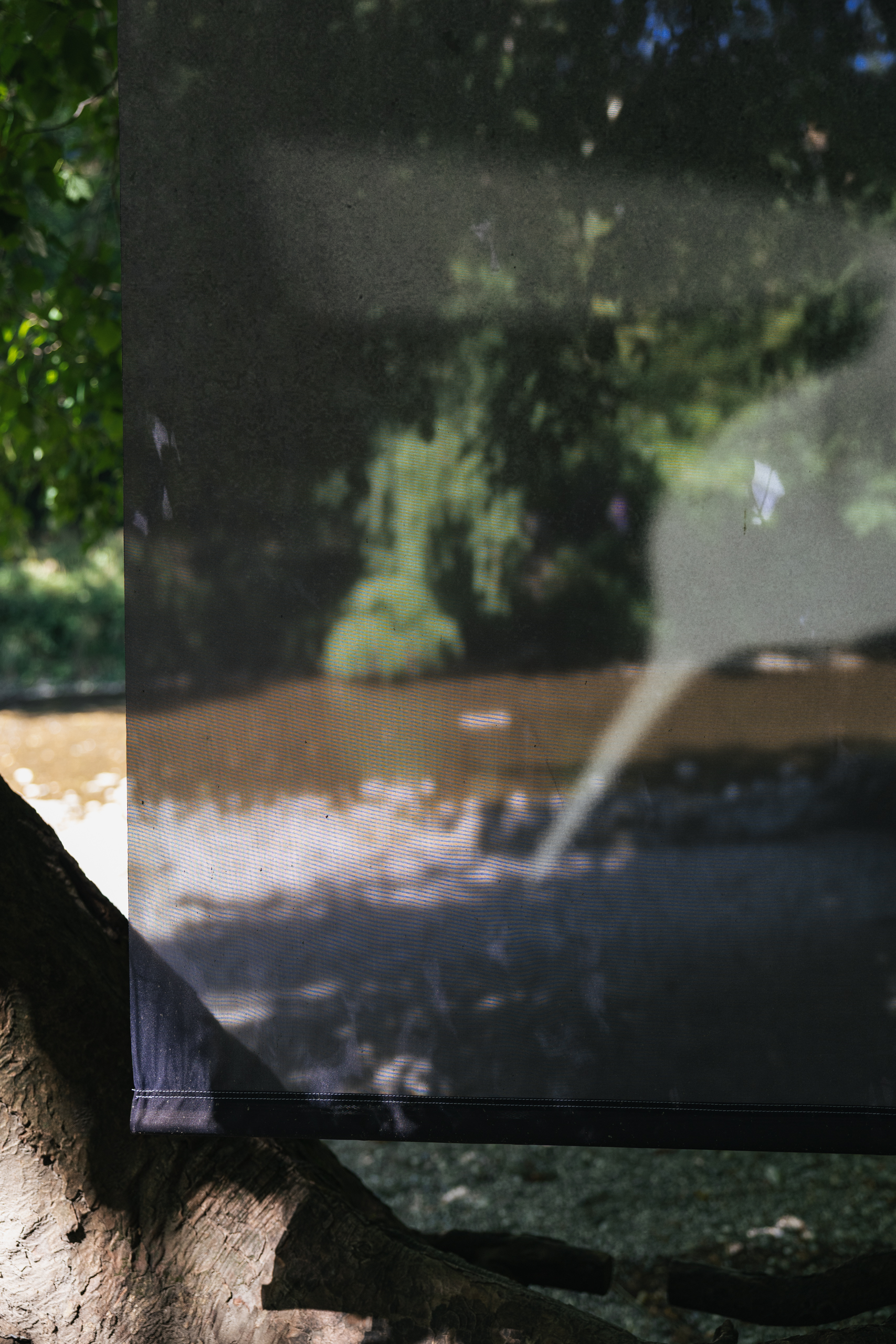
Exhibition set-up, “Glimmers, Feathers and Staring Skies”, Kranj Foto Fest 2027, photo: Katja Pokorn
You place personal archives in dialogue with colonial and ornithological materials while examining photography’s historical impulse to capture, verify and classify a fleeting body. How do you approach these different materials formally, and how might photography move from an instrument of classification towards the practice of care you describe in the statement?
My approach to working with different archives comes from the idea of reanimation, or reactivation. I think of an archive not as a closed repository of information, but as something that can become active again when it is placed in relation to other images, histories, and forms of knowledge in the present. Each archive activates different threads, and those threads can expand the research by introducing new layers, contradictions, and associations. Part of this process involves intervening in the archive. On one level, the intervention establishes my agency and acknowledges that I am not approaching these materials from a neutral position. On another, it allows the images to move beyond the particular institutional or ideological structure in which they were originally produced and to enter into new relationships.
The intervention might take the form of reframing an image, bringing together materials from different archives, physically altering an archival reproduction, or combining historical material with images I have produced myself. These gestures can shift an image away from its original function, or make the assumptions embedded within that function more visible. In the case of ornithological images, for example, I am interested in what happens when an image originally produced for scientific observation and classification is placed alongside family photographs, spiritual beliefs, landscape, or bodily experiences. These materials do not necessarily agree with one another, and I think that tension is important.
I also understand the research as a constellation. The individual images are important, but I am often more interested in the relationships that emerge between them. One image can alter the meaning of another, and an image can activate a memory, a historical association, or a question that would not necessarily be visible on its own. The constellation allows the materials to retain their multiplicity rather than forcing them into a single narrative. This is where the idea of care enters the formal language of the project. I want to create conditions in which the hummingbird is not reduced to an object being observed, captured, or classified, but can remain an active presence within the work. I look for images and relationships that can hold ambiguity and make space for ideas of kinship, spirituality, care, presence, and affect alongside scientific knowledge. For me, moving photography toward care also involves changing the afterlife of images. Some of the historical images I work with were produced within systems of collection, classification, and unequal power. I cannot undo the conditions in which they were made, but I can bring them into another context and ask what other relationships they might sustain. In that sense, the intervention becomes a form of redirection: allowing an image that once participated in a classificatory system to enter an affective and relational space.
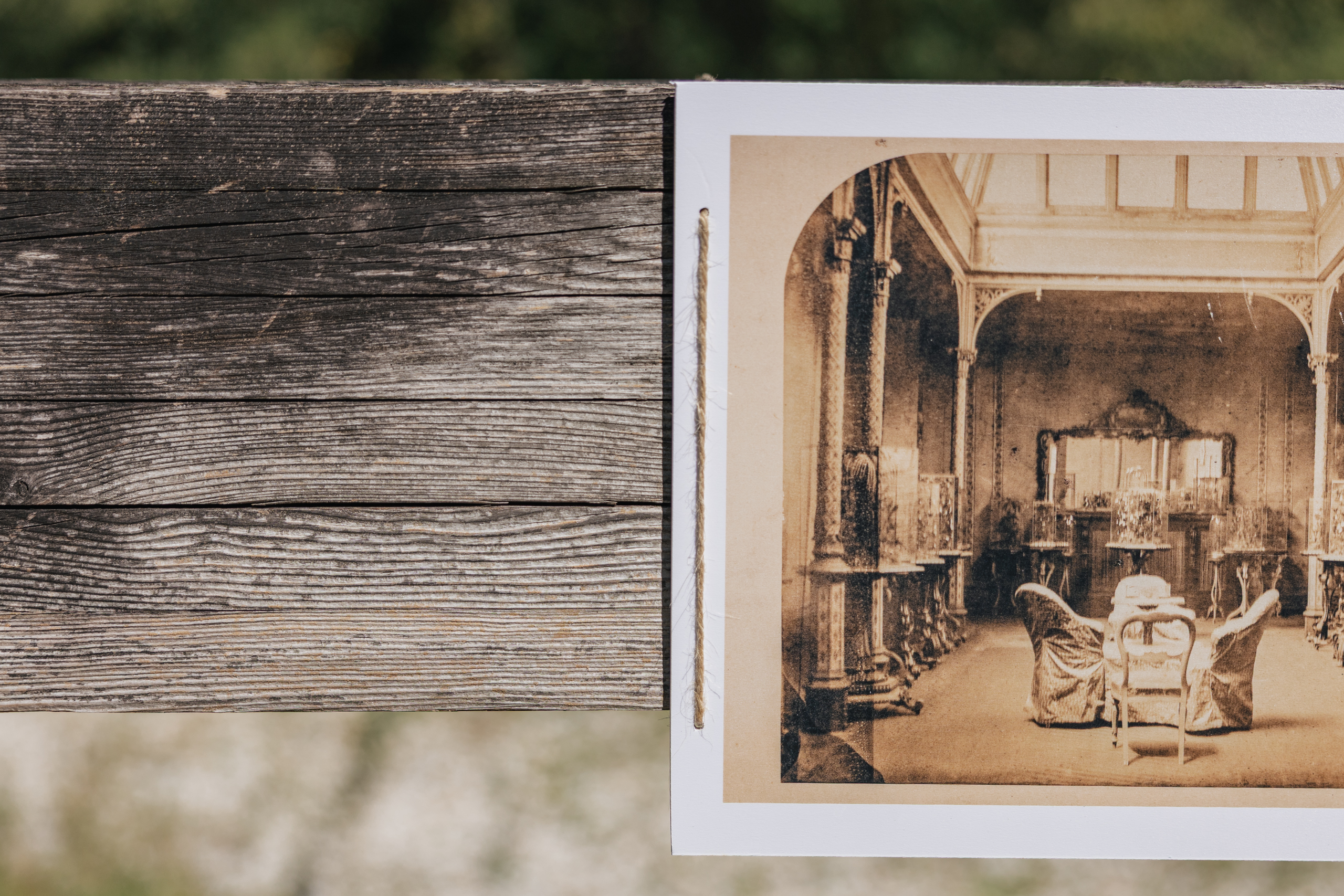
Exhibition set-up, “Glimmers, Feathers and Staring Skies”, Kranj Foto Fest 2027, photo: Katja Pokorn
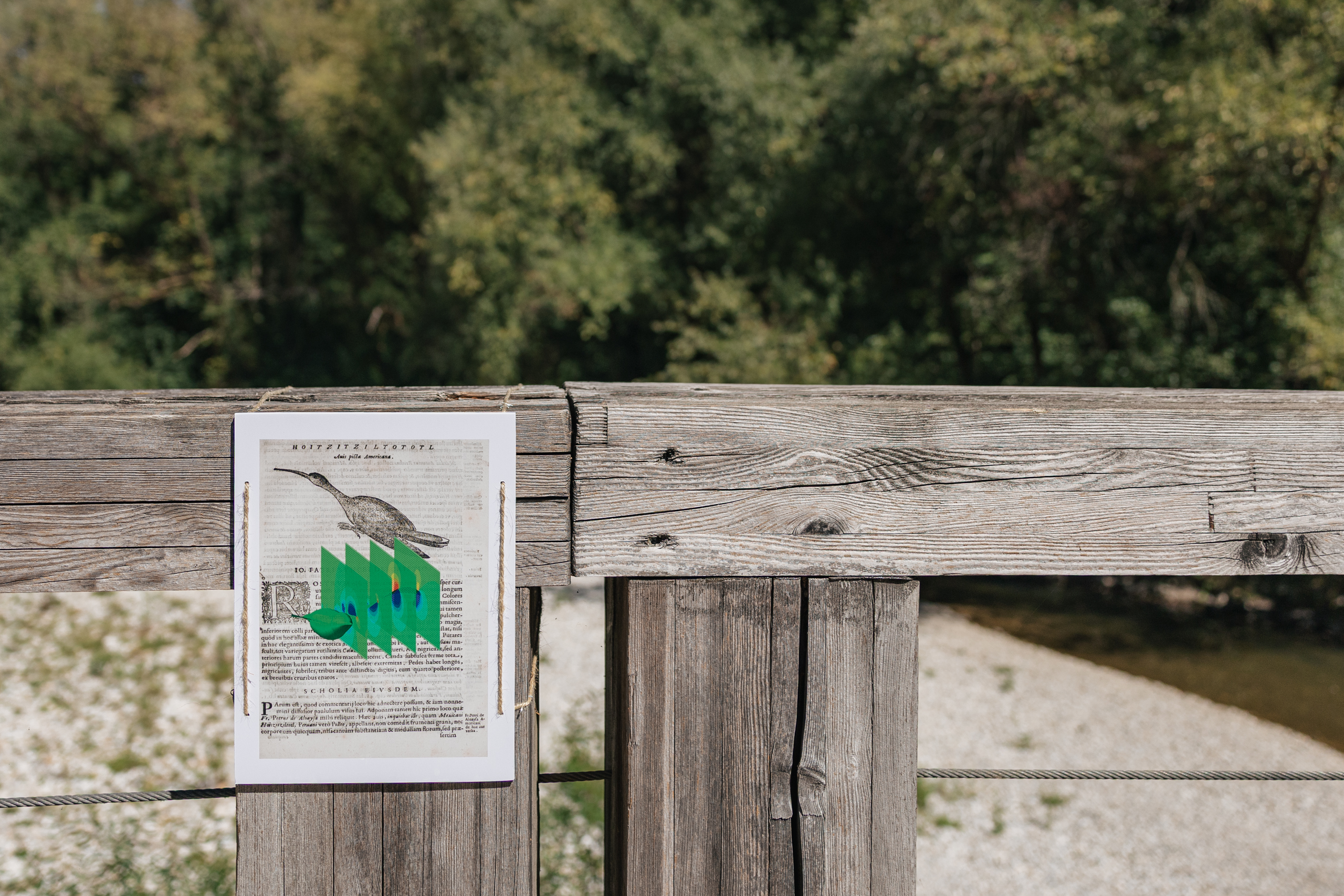
Exhibition set-up, “Glimmers, Feathers and Staring Skies”, Kranj Foto Fest 2027, photo: Katja Pokorn
Photography festivals can create unusually direct encounters between artists and audiences. How often do you have the opportunity to speak with viewers about their experience of your work? Did any of the responses or conversations in Kranj reveal an interpretation of Glimmers, Feathers and Staring Skies that surprised you or shifted your own understanding of the project?
I believe that the possibility of conversation is an important part of the project itself. Whenever the work is shown, I try to establish a context in which the exhibition can become a communal space for these stories, rather than simply a place where the images are presented to an audience. For me, that also means creating a space where the conversation is not unidirectional. I try to slow down the pace of the encounter, sometimes by sitting together in a circle, and by acknowledging the vulnerability that the work activates in me. I am very open about telling the story of my father and the hummingbird because I think that vulnerability can create a different kind of relationship with the audience. I am not asking people to simply interpret an artwork; I am also sharing something that is still emotionally present in my own life.
What I have found most humbling is the generosity with which people respond by sharing their own experiences. In Kranj, after I spoke about the project, many people began talking about their own experiences of grief and about their relationships with the natural world. What initially seemed like a presentation of a very personal story gradually became a gathering in which different experiences could meet. There was a sense of healing, bonding, and community that I could not have planned or produced on my own. That experience also changed something in my understanding of the work. It reminded me that once a project enters the world, it no longer belongs entirely to the person who made it. I may begin with my father, my family, and the hummingbird, but the work can activate experiences that I could never have anticipated. In that sense, it has a life beyond my intentions.
I also think this relates to the idea of narration within the project. I want the space in which the work exists to feel as horizontal as possible. I am a narrator, but I do not want to position myself as the singular authority over the story. The hummingbird is also a presence that participates in the narration, and so are the archival images, my family, and the people who encounter the work. Their responses become part of the work’s ongoing life. What happened in Kranj made that particularly tangible for me. People did not simply tell me what they thought about the photographs. They brought their own memories, losses, beliefs, and relationships with the natural world into the space. For me, that is one of the most meaningful possibilities of the project: that a story that began as a way of honoring my father can become a space through which other people are able to honor, remember, or reconsider their own relationships with death, memory, and the more-than-human world.
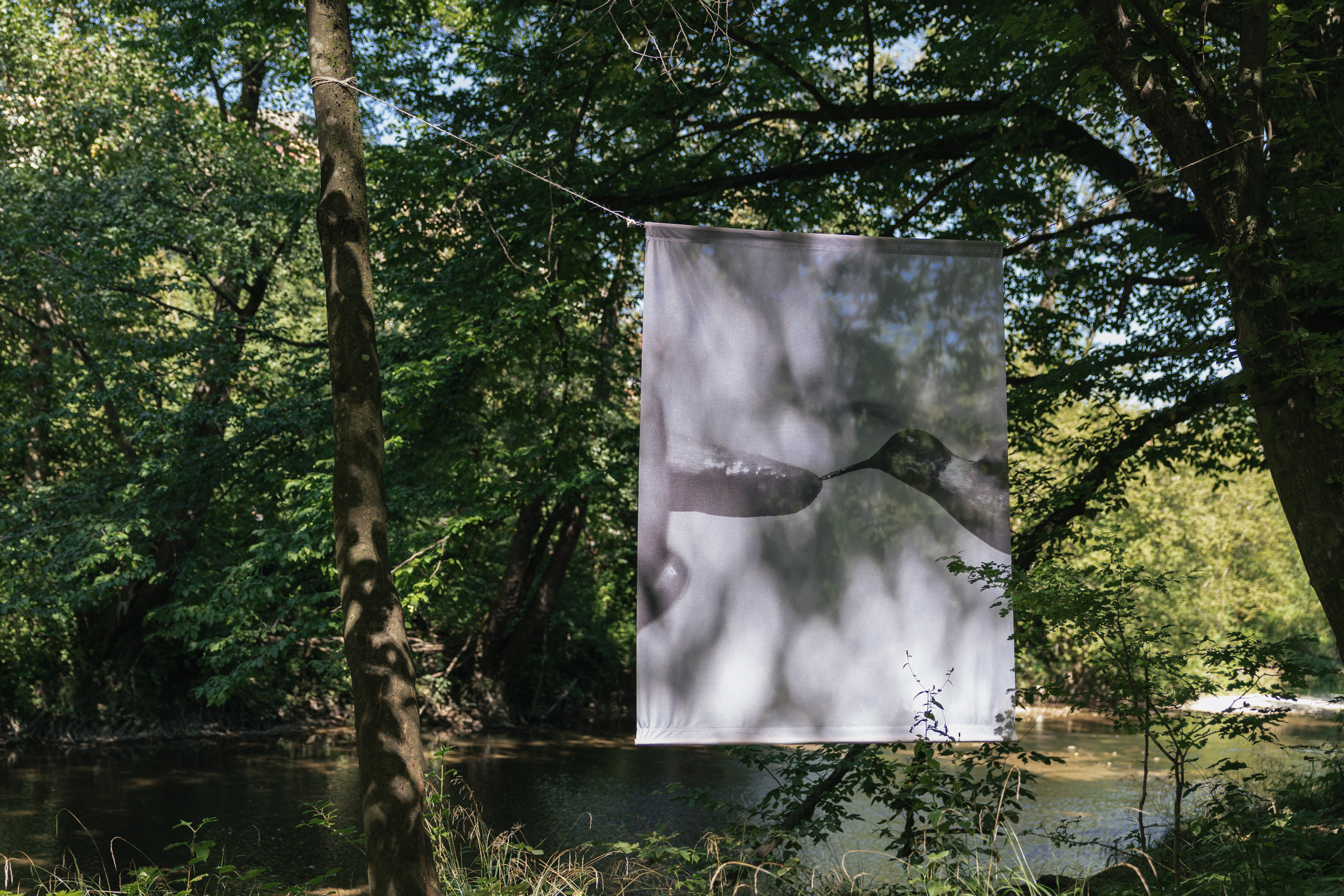
Exhibition set-up, “Glimmers, Feathers and Staring Skies”, Kranj Foto Fest 2027, photo: Katja Pokorn
One of the aspects of the Kranj installation that affected me most was its location in the Kokra River canyon. As I looked at your photographs, I could hear the live birdsong around me, and the natural soundscape became inseparable from my experience of the work. To what extent was this soundscape part of how you imagined the installation, and did encountering the finished work in situ reveal any new dimensions of the project to you?
I had known about Kranj Photo Festival for some time, and I was aware that one of its exhibition locations was the canyon and surrounding forest. So I was very happy when Fernanda, who does an amazing job with the festival, proposed showing the project in that particular location. From the first stages of thinking about how the project could be exhibited, I had imagined it in relation to a natural environment. This felt coherent with the ideas of ecological coexistence and interspecies relations that run through the project. More than simply providing a backdrop for the photographs, I was interested in how the landscape could become another presence within the work, allowing the images and the environment to affect one another.
Seeing the installation in Kranj made that relationship much more tangible than I had imagined. The photographs were embraced by the trees, touched by the wind, and surrounded by birdsong and the sound of the river. The natural soundscape was not something I had produced or added to the work, but it became an essential part of how the work was experienced. The images entered an environment that was already alive, rather than creating an environment around themselves. This was particularly meaningful in relation to the project because it shifted the position of the viewer. Instead of encountering the photographs as isolated objects to be observed from a distance, the viewer was physically situated within a larger ecosystem. The birds, the river, the trees, the wind, the photographs, and the body of the viewer were all participating in the same perceptual field. For me, this brought the project’s interest in the more-than-human world into the experience of looking itself, and it allowed the sensorial dimension to become more prominent than the hierarchical, distanced gaze that the project questions.
The experience also made me think more seriously about how some of these qualities could be brought into institutional exhibition spaces. I don’t necessarily want to reproduce the canyon artificially inside a gallery or museum. Instead, I am interested in researching how the conditions that made that encounter possible could be translated through other means: materiality, sound, spatial relationships, scale, light, or the movement of the viewer. That feels particularly important to me because institutional spaces are never neutral contexts. They already carry particular histories, hierarchies, and ways of directing attention. The Kranj installation reminded me that the exhibition space itself can become part of the research, and that sometimes the most interesting question is not how to recreate a particular environment, but how to create conditions in which the viewer can experience a similar sense of permeability and relation.
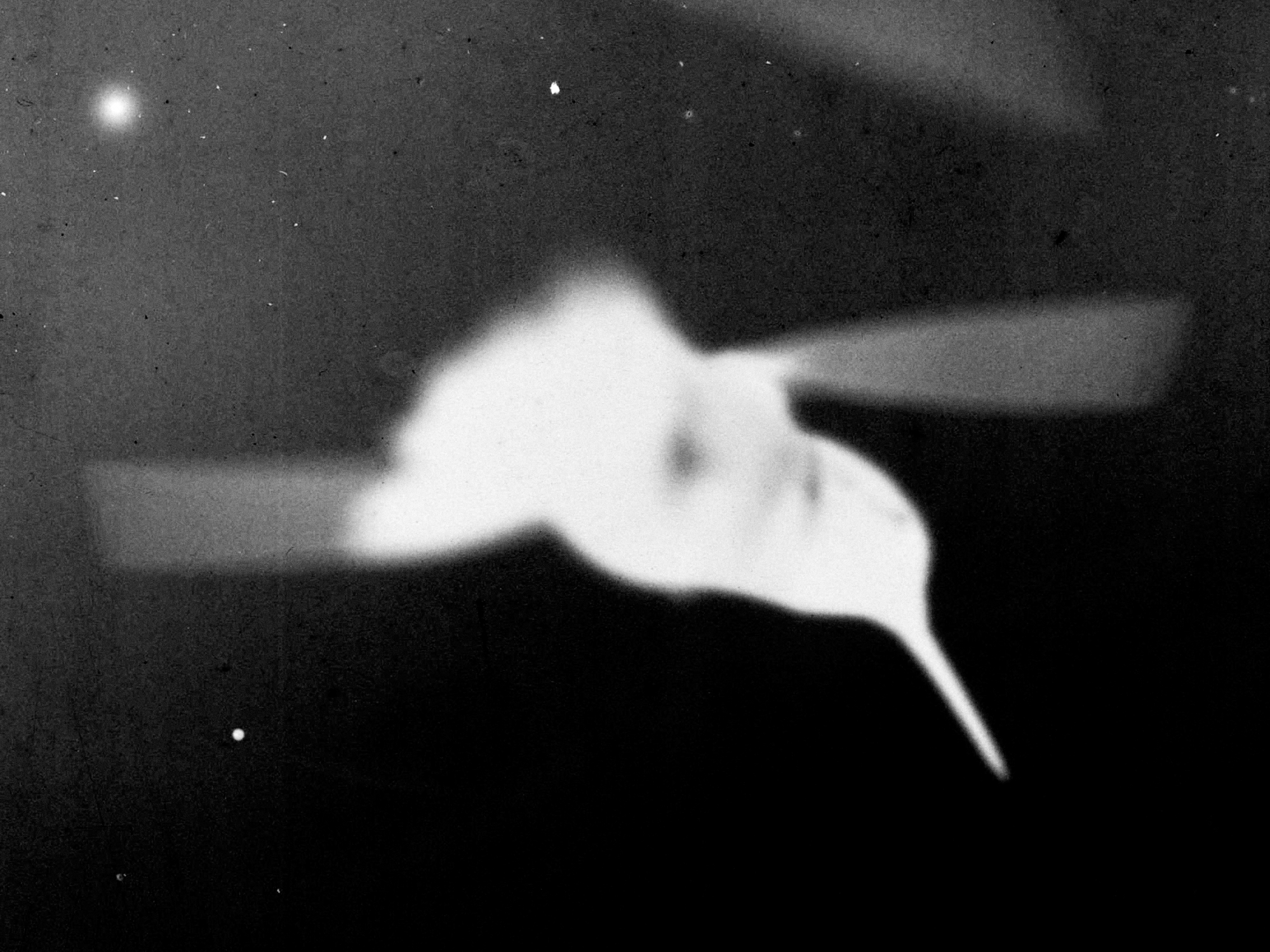
From the project “Glimmers, Feathers and Staring Skies”
Glimmers, Feathers and Staring Skies is an ongoing project. Which questions or aspects of the work remain open for you, and how do you imagine its future development?
I currently understand the project as developing through two main phases. The body of work exhibited in Kranj forms the first phase. I consider that part of the research complete, although I expect it to continue evolving through different forms of display and through the contexts in which it is encountered.
In this first phase, I was primarily exploring the personal story of my grief and my family, together with the cultural and mythological understandings surrounding the hummingbird, placing these in dialogue with the scientific and ornithological gaze through which the bird has historically been observed and classified. The work established the main questions of the project and allowed me to understand the hummingbird as a point of intersection between personal memory, grief, migration, spirituality, and histories of knowledge. The second phase will move from working primarily with existing archives toward producing my own photographic material. I am interested in developing this through two interconnected areas of research.
The first concerns the historical trace of the hummingbird within European institutional spaces, particularly natural history museums and their collections. I want to research what happens behind the displays: the collections, storage spaces, conservation practices, taxidermy, cataloguing systems, and other gestures through which knowledge about the hummingbird has been produced and preserved. I am interested in creating images within these contexts that move between documentary and fiction, while also developing a moving-image work. Rather than simply photographing these spaces as evidence, I want to explore how their architecture, objects, procedures, and displays reveal the ways in which a particular understanding of nature is constructed. The second area moves in almost the opposite direction. I want to research places where relationships with hummingbirds are based more explicitly on coexistence, care, or ecological preservation. Hummingbird sanctuaries are particularly interesting to me, including spaces where people work to protect habitats and others where people travel specifically to encounter and observe these birds. I want to understand the different relationships that emerge in these contexts through images, voices, and texts, and to explore how human and more-than-human forms of life become connected through practices of attention and care. I am interested in keeping these two areas of research in tension rather than presenting them as a simple opposition between violence and care. Both are ways of producing relationships with the hummingbird, and I want to investigate what those relationships reveal about how humans construct knowledge, attachment, protection, and proximity to other forms of life.
Developing this second phase will require substantial travel and accommodation costs, so I am currently applying for grants and funding that could support the research. I also see the project ultimately becoming a photobook, but I don’t want to think of the book simply as a container for the images produced across these phases. I would like it to become another space in which the different temporalities, archives, voices, and forms of knowledge within the project can enter into relation with one another. In that sense, some questions will remain deliberately open. How can photography engage with a living being without reducing it to an image? What does it mean to preserve something without possessing it? Can an archive become a space of relation rather than simply a record of the past? And how might we develop forms of attention that allow us to encounter the more-than-human world without immediately translating it into our own systems of knowledge?
We thank Kranj Foto Fest and the artist for providing the photographs of the exhibition installation.
This text was published as part of the “Photographic Practices: Analyses and Dialogues” programme, co-funded by the Fund for the Encouragement of Pluralism and Diversity of Electronic Media.